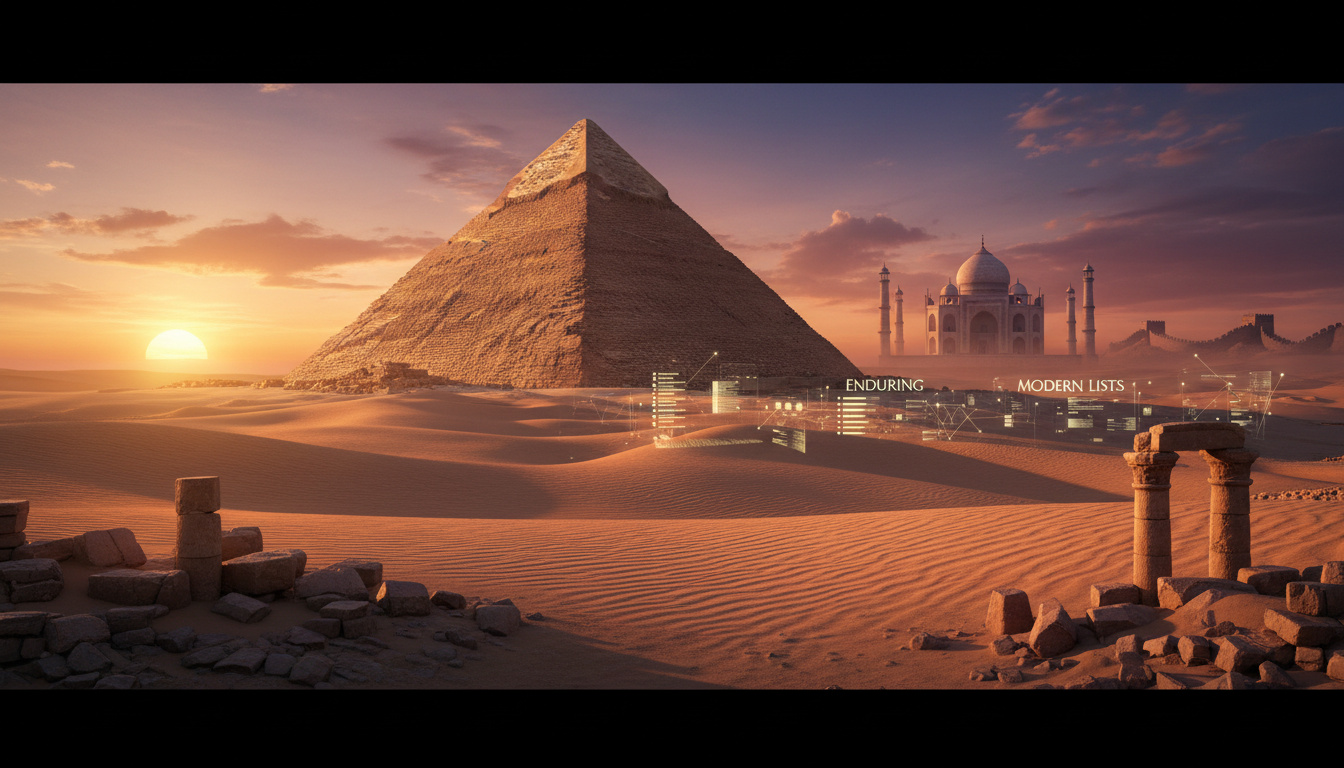
The phrase seven wonders of the world evokes images of monumental human achievement, yet no single definitive list exists. Multiple compilations circulate today, each representing distinct eras and selection criteria. The ancient canon, rooted in classical Greek travel literature, originally celebrated Mediterranean and Near Eastern marvels. Modern iterations include a popular 2007 global vote that dramatically expanded geographic scope, alongside various natural wonders lists that highlight geological phenomena rather than architecture. Understanding these distinctions requires context, much like understanding What Is Smart Casual – Attire Guide for Men and Women requires understanding specific situational nuances.
Travelers and historians alike encounter confusion when referencing “the” seven wonders. Some intend the classical roster documented by ancient observers; others mean the contemporary sites crowned through internet campaigns. The Great Pyramid of Giza alone bridges both categories, standing as the sole surviving ancient wonder while earning honorary status among modern selections. This article examines the ancient and new lists, their survival status, geographic distribution, and the factual boundaries between established history and persistent mystery.
Archaeological evidence and historical documentation reveal stark differences in how these lists emerged. Ancient compilations reflected Hellenistic worldviews, while contemporary selections emphasize global cultural representation. Both categories, however, share a focus on exceptional engineering and cultural significance that continues driving modern tourism and scholarly inquiry.
What Are the Ancient Seven Wonders of the World?
The Seven Wonders of the Ancient World originated from classical Greek sources dating to the 2nd–1st century BC. These remarkable structures, located around the Mediterranean and Near East, represented the pinnacle of human craftsmanship visible to ancient travelers. The modern canonical list formally crystallized in 1572 through the publication Octo Mundi Miracula, which synthesized earlier fragmentary accounts into a standardized enumeration.
Ancient (BC)
7 man-made marvels around the Mediterranean, only 1 survives today
New (2007)
Global public vote with 100M participants, includes honorary Pyramid
Natural
Alternative lists featuring geological wonders like Iguazu Falls
Common Query
Great Pyramid of Giza remains the sole intact ancient wonder
Key Facts About the Ancient Canon
- Pyramid only intact: The Great Pyramid at Giza stands as the only surviving ancient wonder, constructed approximately 2580–2560 BC.
- Symbolic number: Seven represented perfection in ancient Greek thought, matching the five known planets plus the Sun and Moon.
- Geographic clustering: All ancient wonders concentrated in Egypt, Greece, Turkey, and modern-day Iraq.
- Destruction pattern: Four succumbed to earthquakes; two fell to fire or armed conflict.
- List evolution: At least eight distinct ancient lists existed, with variations like the Walls of Babylon appearing alongside canonical entries.
- Documentation: Antipater of Sidon provided the most influential account around 100 BC.
Complete Ancient Wonders Reference
| Wonder | List Type | Location | Status | Built |
|---|---|---|---|---|
| Great Pyramid of Giza | Ancient | Giza, Egypt | Intact | ~2580–2560 BC |
| Colossus of Rhodes | Ancient | Rhodes, Greece | Destroyed (226 BC) | ~292–280 BC |
| Lighthouse of Alexandria | Ancient | Alexandria, Egypt | Collapsed (earthquakes) | ~280–247 BC |
| Mausoleum at Halicarnassus | Ancient | Bodrum, Turkey | Ruined (earthquakes) | ~353 BC |
| Temple of Artemis | Ancient | Selçuk, Turkey | Destroyed (arson/Goths) | ~550 BC |
| Statue of Zeus at Olympia | Ancient | Olympia, Greece | Destroyed (fire) | ~435 BC |
| Hanging Gardens of Babylon | Ancient | Babylon/Nineveh, Iraq | Existence debated | Unknown |
| Great Wall of China | New | China | Extant | Various (7th century BC–16th century AD) |
| Colosseum | New | Rome, Italy | Extant | 70–80 AD |
| Taj Mahal | New | Agra, India | Extant | 1632–1653 |
Ancient authors including Herodotus and Philon of Byzantium initially cataloged these sites as travel guides for Athenian tourists. Over centuries, the lists evolved through Roman, Medieval, and Renaissance interpretations, with some versions incorporating the Colosseum or Noah’s Ark before the 1572 standardization settled the canonical seven. Historical documentation confirms that no ancient list perfectly matches the modern canonical version.
What Are the New Seven Wonders of the World?
In 2000, a Swiss foundation launched an ambitious campaign to update the ancient roster for contemporary global consciousness. The initiative culminated in a 2007 vote that engaged over 100 million participants through internet and text messaging platforms. Unlike the ancient list’s Hellenistic focus, this modern selection emphasizes cultural representation across continents, recognizing sites from Asia, the Americas, and the Middle East alongside European landmarks.
Results were announced on July 7, 2007, following expert panel review of the public voting data. The final roster includes the Great Wall of China, representing thousands of kilometers of defensive engineering; Chichén Itzá in Mexico, showcasing Mayan astronomical precision; Jordan’s rock-cut city of Petra; Peru’s mountain sanctuary Machu Picchu; Brazil’s Christ the Redeemer statue; Rome’s Colosseum; and India’s Taj Mahal. These selections reflect living heritage sites accessible to contemporary travelers, much like following Crystal Palace vs Fredrikstad – 1-0 Aggregate Win in Conference League represents engaging with current international competitions.
Who Selected the New Seven Wonders?
The New7Wonders Foundation, established by Swiss-born Canadian filmmaker Bernard Weber, orchestrated the selection process. While the foundation organized the campaign and tabulated votes, an expert panel verified the final results to ensure legitimacy. Britannica archives note that this democratic approach contrasted sharply with the ancient lists, which emerged from individual chroniclers rather than collective global input.
How Were They Chosen?
The selection methodology combined public participation with expert oversight. Voters cast ballots via internet and SMS between 2000 and 2007, narrowing an initial pool of 200 monuments to 21 finalists before selecting the ultimate seven. The Great Pyramid of Giza received honorary status as the only surviving ancient wonder, though it did not compete in the final voting round. Foundation records indicate the process prioritized cultural significance, architectural innovation, and global geographic distribution.
Which Seven Wonders Still Exist Today?
Physical survival separates the ancient and modern lists dramatically. Only one ancient structure remains substantially intact, while all seven modern selections stand in varying states of preservation. This disparity stems from geological vulnerability, armed conflict, and the passage of millennia that claimed six of the seven ancient sites.
The Sole Ancient Survivor
The Great Pyramid of Giza stands alone as the only surviving ancient wonder. Built during Egypt’s Fourth Dynasty around 2560 BC, the pyramid has endured looting, erosion, and urban encroachment yet retains its core structural integrity. Archaeologists attribute its survival to massive limestone and granite construction, relatively stable seismic conditions in the Giza plateau, and continuous cultural significance that prevented complete dismantling.
The Great Pyramid’s solid construction and desert location protected it from the earthquakes that destroyed four other ancient wonders. Its scale and durability prompted ancient chroniclers to place it first in early lists.
Remains and Ruins
While the Colossus of Rhodes, Lighthouse of Alexandria, and Statue of Zeus disappeared entirely, three ancient wonders left archaeological traces. The Mausoleum at Halicarnassus supplied marble fragments now displayed in the British Museum and Bodrum’s local museum. The Temple of Artemis yielded scattered column drums and sculptural remnants excavated at Ephesus. Lighthouse of Alexandria stones were repurposed into coastal fortifications, with some material identified on the harbor floor. Archaeological surveys confirm these fragments while emphasizing that reconstruction remains impossible.
Excavations at Halicarnassus and Ephesus have recovered sufficient material to reconstruct partial elevations of the Mausoleum and Temple of Artemis, allowing scholars to verify ancient descriptions against physical remains.
The Uncertain Case
The Hanging Gardens of Babylon present unique historiographic challenges. No definitive archaeological evidence confirms their existence at Babylon or alternative locations such as Nineveh. Ancient writers described terraced greenery irrigated by the Euphrates, yet contemporary excavations have not identified the described structure. Specialized analyses suggest the gardens may represent confused memories of Assyrian royal gardens or entirely legendary constructions. If they existed, earthquakes likely destroyed them as with other Mesopotamian architecture.
Unlike other ancient wonders with confirmed locations, the Hanging Gardens’ very existence remains debated among scholars. No cuneiform tablets or archaeological layers definitively support the classical Greek accounts.
Where Are the Seven Wonders Located?
Geographic distribution reveals the ancient lists’ Hellenistic bias versus the modern selections’ global reach. Ancient wonders clustered within the sphere of Greek travel and trade routes, while contemporary sites span four continents and multiple climatic zones.
Ancient Wonder Locations
The canonical ancient wonders occupied territories now within four modern nations. Egypt hosted two sites: the Great Pyramid at Giza and the Lighthouse of Alexandria. Greece claimed the Colossus of Rhodes and the Statue of Zeus at Olympia. Turkey contained the Mausoleum at Halicarnassus (modern Bodrum) and the Temple of Artemis near Ephesus (modern Selçuk). The Hanging Gardens, whether located at Babylon or Nineveh, would stand within modern Iraq. Geographic analysis shows all sites lay within approximately 2,500 kilometers of each other, reflecting ancient Mediterranean connectivity. The geographic distribution of these ancient sites, all within approximately 2,500 kilometers of each other, reflects ancient Mediterranean connectivity, a concept that also applies to how we get rid of eye bags.
New Wonder Distribution
The 2007 selections expanded coverage significantly. Asia contributes the Great Wall of China, Petra in Jordan, and the Taj Mahal in India. The Americas are represented by Chichén Itzá in Mexico and Machu Picchu in Peru, plus Christ the Redeemer in Brazil. Europe retains the Colosseum in Rome as its sole representative. This distribution acknowledges architectural achievements beyond classical antiquity’s geographic scope, recognizing Incan, Mughal, and Mayan engineering alongside Roman and Chinese traditions.
How Did the Seven Wonders Lists Evolve Over Time?
The concept of cataloging exceptional monuments emerged gradually, solidifying over two millennia of travel writing and scholarly compilation.
- : Completion of Great Pyramid of Giza, eventually becoming the oldest wonder.
- : Construction of Lighthouse of Alexandria, among the last ancient wonders built.
- : Philon of Byzantium drafts early travel guide lists for Athenian tourists.
- : Publication of Octo Mundi Miracula formalizes the canonical seven.
- : New7Wonders Foundation launches campaign to modernize the list.
- : Announcement of New Seven Wonders following 100 million votes. Contemporary reports document the global broadcast.
What Do We Know for Certain?
Distinguishing established facts from contested claims helps navigate the extensive literature surrounding these monuments.
| Established Information | Information That Remains Unclear |
|---|---|
| Great Pyramid is the sole intact ancient wonder | Exact location of Hanging Gardens (Babylon vs Nineveh) |
| New Seven Wonders selected via 2007 global vote | Whether Hanging Gardens existed at all |
| Six ancient wonders destroyed by earthquakes or fire | Precise appearance of Colossus of Rhodes (bronze color confirmed, posture debated) |
| New list includes Great Wall, Taj Mahal, and Colosseum | Exact date of Statue of Zeus destruction (5th century AD approximated) |
| Remains exist for Mausoleum, Temple of Artemis, and Lighthouse | Original height of Lighthouse of Alexandria (estimates vary 100–140 meters) |
How Do Ancient and Modern Lists Compare?
The ancient and new rosters differ fundamentally in origin, geography, and survival status. Ancient selections emerged from individual Greek chroniclers documenting accessible Mediterranean sites, while modern choices resulted from organized global democracy spanning internet and mobile voting. The ancient list focused exclusively on pre-Christian era construction within a limited geographic radius; the 2007 roster encompasses structures from the 5th century BC through the 17th century AD across four continents.
Selection criteria also diverged. Ancient authors prioritized technical virtuosity and religious significance within their cultural sphere. The New7Wonders campaign emphasized global representation, living accessibility, and cultural diversity. Consequently, the modern list includes religious monuments (Christ the Redeemer), defensive engineering (Great Wall), and imperial tombs (Taj Mahal) that ancient Greek observers never encountered. Comparative studies note that while ancient wonders were mostly lost to natural disasters, modern conservation efforts preserve the 2007 selections for contemporary visitation.
Natural wonders lists constitute a third category, recognizing geological formations like Iguazu Falls, Hạ Long Bay, and Mount Everest rather than human construction. These lack canonical standardization but share the ancient and new lists’ goal of highlighting exceptional global sites.
What Do Historical Sources Say?
Primary documentation provides fragmented yet crucial insights into how these monuments were perceived and preserved.
I have set eyes on the wall of lofty Babylon on which is a road for chariots, and the statue of Zeus by the Alpheus, and the hanging gardens, and the Colossus of the Sun, and the huge labor of the high pyramids, and the vast tomb of Mausolus; but when I saw the house of Artemis that mounted to the clouds, those other marvels lost their brilliancy, and I said, ‘Lo, apart from Olympus, the Sun never looked on aught so grand.’
— Antipater of Sidon, ~100 BC (Greek Anthology 9.58)
The campaign to elect the New Seven Wonders of the World represents the first global democratic exercise in history, with over 100 million votes cast from every corner of the planet to celebrate our shared cultural heritage.
— New7Wonders Foundation, July 7, 2007 Announcement
Herodotus provided the earliest references in the 5th century BC, though his lists were incomplete. Diodorus Siculus expanded coverage in the 1st century BC, while Gregory of Tours later incorporated medieval additions like the Colosseum. These evolving accounts demonstrate that wonder lists always reflected contemporary knowledge rather than fixed eternal inventories.
What Defines the Seven Wonders Today?
The seven wonders of the world encompass multiple valid lists reflecting different eras and criteria. The ancient canon, formalized in 1572 but rooted in 2nd century BC Greek travel writing, includes the Great Pyramid of Giza as its sole surviving member alongside six lost Mediterranean and Near Eastern monuments. The New Seven Wonders, democratically selected in 2007 by 100 million global voters, comprise extant sites across four continents including the Great Wall, Taj Mahal, and Machu Picchu. While natural wonders lists offer additional categories, these two primary rosters dominate cultural consciousness—one representing ancient Mediterranean achievement, the other global heritage preservation. For further reading on contemporary achievements, see Crystal Palace vs Fredrikstad – 1-0 Aggregate Win in Conference League.
Frequently Asked Questions
Who selected the new seven wonders?
The New7Wonders Foundation, a Swiss-based organization led by Bernard Weber, orchestrated the 2007 selection through global public voting reviewed by expert panels.
How were the new seven wonders chosen?
Over 100 million votes cast via internet and SMS between 2000–2007 narrowed 200 initial monuments to 21 finalists, then to seven winners announced July 7, 2007.
Is the Great Wall of China one of the seven wonders?
Yes, the Great Wall appears in the 2007 New Seven Wonders list, though not in the ancient canon which predated widespread Greek knowledge of Chinese architecture.
Are there seven natural wonders of the world?
Multiple natural wonders lists exist, commonly including Iguazu Falls, Hạ Long Bay, and Mount Everest, but no single canonical natural seven has achieved universal standardization.
Why is the Great Pyramid the only surviving ancient wonder?
Its massive stone construction, stable desert geology, and cultural continuity protected it from earthquakes and dismantling that destroyed the other six ancient monuments.
What happened to the ancient seven wonders?
Four succumbed to earthquakes (Colossus, Lighthouse, Mausoleum, Hanging Gardens if real), two to fire (Zeus statue, Temple of Artemis arson), leaving only the Pyramid intact.