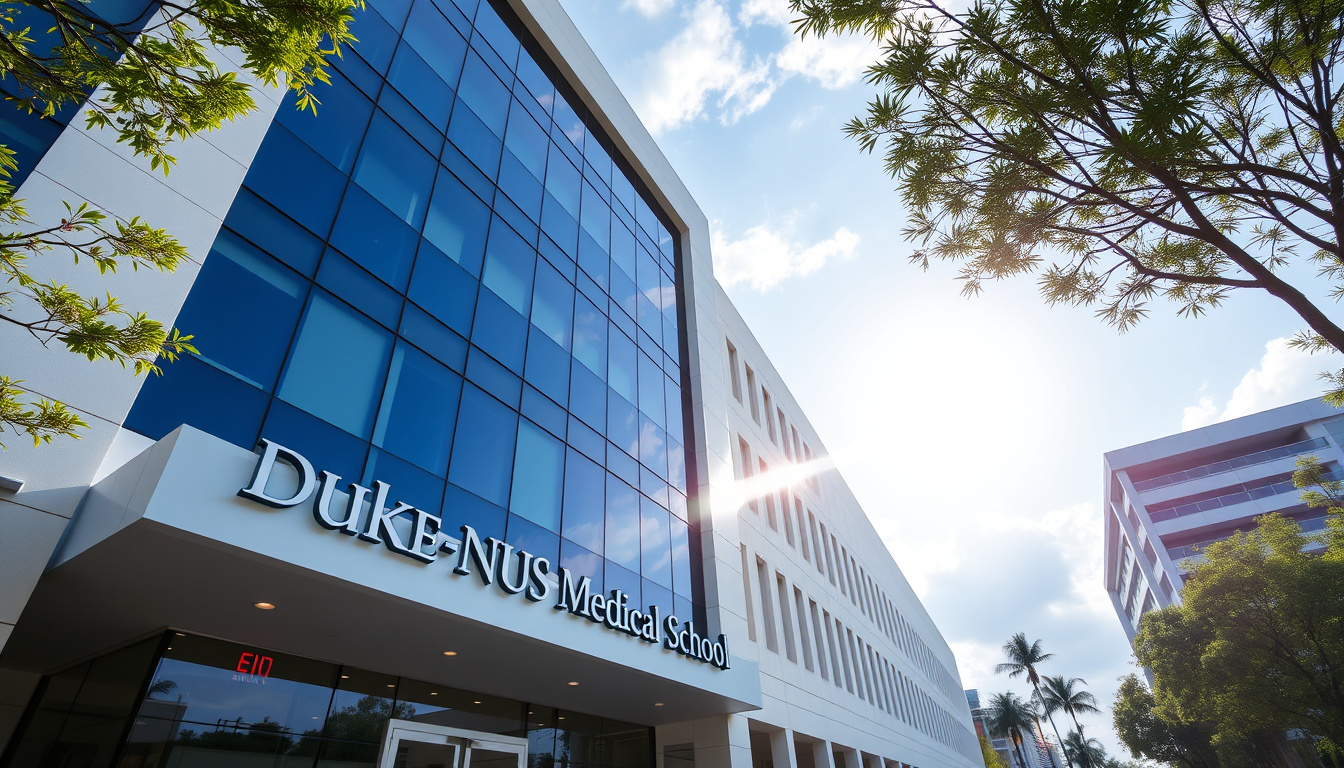
Anyone who’s looked into studying medicine in Singapore will quickly realize it’s an exclusive club, and Duke-NUS Medical School is the country’s only graduate-entry MD program, a partnership between Duke University and the National University of Singapore that has produced some of the region’s top clinicians since 2005. This guide walks through what it takes to get in, what it costs, and whether the prestige matches the price tag.
Founded: 2005 ·
Program Duration: 4 years ·
Degree Awarded: MD ·
Partnership: Duke University & National University of Singapore ·
Entry Type: Graduate-entry (post-baccalaureate)
Quick snapshot
- Graduate-entry MD program founded 2005 (Duke-NUS Medical School (official))
- Accepts any nationality; student body spans 28+ countries (Duke-NUS FAQ (official))
- Tuition fixed for four years per cohort (Duke-NUS tuition page (official))
- Exact acceptance rate not publicly released by Duke-NUS
- Minimum GPA cutoff varies by application cycle
- Exact tuition fees for AY2025 not yet published
- Application deadline for August 2025 intake: typically January (Duke-NUS required timeline (official))
- AY2026-2027 fee schedule confirmed; financial aid covering 40-80% of tuition launching for AY2025 cohort (Duke-NUS tuition page (official))
Seven key facts about Duke-NUS at a glance, one pattern: the school is transparent about admissions policy but notably opaque about selectivity — which is common among elite graduate medical schools globally.
| Fact | Detail |
|---|---|
| Founded | 2005 |
| Duration | 4 years |
| Degree | MD |
| Partnership | Duke University and National University of Singapore |
| Tuition (AY2026-2027) | SGD 50,050 (Singapore Citizen), SGD 68,150 (PR), SGD 99,900 (International) |
| Acceptance Rate | Not publicly disclosed; estimated ~3.2% by third-party sources |
| Application Deadline | Typically January for August intake |
Is it hard to get into Duke-NUS Medical School?
Short answer: yes — and the school doesn’t sugarcoat it. Duke-NUS is a graduate-entry program that demands a bachelor’s degree, competitive MCAT or GAMSAT scores, and a multi-stage interview process. The school does not publish an official acceptance rate, but third-party education consultancies estimate it at around 3.2% (Icon Education (admissions consultancy estimate)). While not Duke-NUS-verified, that figure aligns with the selectivity of top US MD programs.
What GPA do you need for Duke-NUS Medical School?
- Minimum GPA requirement is typically around 3.0 on a 4.0 scale (Duke-NUS Admissions Requirements (official))
- Competitive applicants generally present GPAs well above 3.5
- No specific cutoff is publicly fixed; the admissions committee evaluates holistically
The catch: meeting the 3.0 floor does not guarantee an interview. The school’s holistic review means soft factors — research experience, clinical exposure, and personal essays — weigh heavily.
What is the acceptance rate of Duke-NUS Medical School?
- Duke-NUS has never published an official acceptance rate
- Third-party sources cite an estimate of ~3.2% (Gateway Plus (admissions consultancy estimate))
- Compared to US allopathic schools’ average ~5.5% in 2023, that suggests intense competition
A Singaporean applicant with a 3.8 GPA and strong MCAT faces lower odds at Duke-NUS (~3.2% estimated) than at the National University of Singapore’s undergraduate medical program (~10-15% estimated), but the MD pathway offers a distinctly American-style curriculum and Duke’s brand recognition in Asia.
The implication: applicants should treat Duke-NUS as a reach school regardless of credentials. Diversifying across US, Australian, and UK graduate-entry programs is strategic.
How to get into Duke-NUS Medical School
Duke-NUS runs a structured admissions process that mirrors US MD programs but includes Singapore-specific requirements like National Service completion for male citizens and permanent residents.
- Complete a bachelor’s degree from an accredited institution.
- Fulfill pre-medical science prerequisites (biology, chemistry, physics, mathematics).
- Take the MCAT or GAMSAT and submit scores.
- Complete the online application by the January deadline.
- Attend interviews if invited (February-April).
- For international students, allow time for visa processing; submit by November.
What are the application prerequisites?
- Completed or final-year bachelor’s degree from an accredited institution (Duke-NUS Admissions Requirements (official))
- MCAT or GAMSAT scores submitted (no minimum score published)
- Applicants must fulfill pre-medical science prerequisites (biology, chemistry, physics, mathematics)
- Male Singapore Citizens and PRs must have completed National Service before matriculation (Duke-NUS National Service policy (official))
What is the application timeline?
- Applications open: typically from June for August intake the following year
- Application deadline: January of the intake year (Duke-NUS application timeline (official))
- Interview invitations: February-April
- Final decisions: May-June
International applicants face the same timeline but must factor in visa processing (typically 4-6 weeks). Duke-NUS recommends international applicants submit by November to allow buffer time.
Why this matters: the January deadline is earlier than most US MD deadlines (which typically run through February), so international students need to coordinate AMCAS or direct applications with Duke-NUS’s schedule.
How many years is Duke-NUS Medical School?
Four years — the same duration as US MD programs. Duke-NUS follows an American-style graduate medical curriculum with three distinct phases.
What is the curriculum structure?
- Year 1: Pre-clinical foundational sciences (normal structure and function, disease mechanisms)
- Year 2: Clinical rotations (internal medicine, surgery, pediatrics, obstetrics and gynecology, psychiatry, family medicine)
- Years 3-4: Advanced clinical rotations, research project, and electives
- Students complete a required research thesis (typically 8-12 weeks) (Duke-NUS Medical School (official))
What degree is awarded?
- Doctor of Medicine (MD) degree
- Jointly awarded by Duke University and National University of Singapore
- Graduates eligible to apply for Singapore Medical Council registration and US residency programs
A Singaporean MD graduate from Duke-NUS can practice in Singapore after completing the compulsory housemanship year, or sit for the USMLE and apply to US residency programs — a flexibility most Asian medical schools don’t offer.
The pattern: Duke-NUS’s curriculum mirrors Duke School of Medicine’s but adapts clinical placements to Singapore’s healthcare system (including mandatory rotations in Singapore public hospitals).
Is Duke-NUS expensive?
Yes — but the financial aid landscape has shifted significantly. Duke-NUS announced for AY2026-2027 that student financial aid will cover roughly 40% to 80% of tuition fees for students enrolling from AY2025 onwards (Duke-NUS Financial Aid (official)).
What are the fees of Duke-NUS Medical School?
| Category | Annual Tuition (AY2026-2027) |
|---|---|
| Singapore Citizen | SGD 50,050 |
| Singapore Permanent Resident | SGD 68,150 |
| International Student | SGD 99,900 |
- Tuition is fixed for the four-year duration of each cohort (Duke-NUS Tuition page (official))
- For PhD (CTS) programme (Intake 2024): annual tuition SGD 28,840 plus miscellaneous fees (Duke-NUS PhD tuition (official))
- A 2022 Straits Times report (Singapore newspaper) noted Singapore citizen tuition at SGD 47,050 at that time, with four-year cost near SGD 200,000 before living expenses
Is Duke-NUS Med good value?
- About three-quarters of MD students take up the Tuition Fee Loan (Duke-NUS Financial Aid (official))
- The Straits Times reported that more than half of Duke-NUS students were on financial aid, with bursaries covering up to 71% of tuition (The Straits Times (Singapore news))
- Duke-NUS says about 40-80% of fees can be covered by financial aid from AY2025 onwards
An international student paying SGD 99,900 annually faces four-year costs of roughly SGD 400,000 before living expenses. Even with the new financial aid (40-80% coverage for all students), the net cost for internationals remains SGD 80,000-240,000 — still among the most expensive medical programs in Asia.
The trade-off: a Singaporean citizen on maximum aid (80%) pays about SGD 10,010 per year — competitive with NUS Yong Loo Lin School of Medicine’s undergraduate fees (around SGD 9,500 for citizens). The value equation shifts dramatically by citizenship status.
Are Duke-NUS and NUS the same?
No — but the relationship is close. Duke-NUS is a separate entity jointly owned by Duke University and the National University of Singapore, operating as an autonomous graduate medical school within the NUS system.
What is the ranking of Duke-NUS Medical School?
- Duke-NUS is not separately ranked by QS or Times Higher Education
- Duke University School of Medicine is ranked #6 in the US for research by U.S. News & World Report (2025)
- National University of Singapore is ranked #1 in Asia by QS World University Rankings (2024)
- Duke-NUS is widely considered a top-tier medical school in Asia by reputation
How does Duke-NUS compare to other medical schools?
| School | Program Type | Duration | Annual Tuition (Local) | Acceptance Rate |
|---|---|---|---|---|
| Duke-NUS Medical School | Graduate-entry MD | 4 years | SGD 50,050 (citizen) | ~3.2% (estimated) |
| NUS Yong Loo Lin School of Medicine | Undergraduate MBBS | 5 years | SGD 28,900 (citizen) | ~10-15% (estimated) |
| Singapore University of Social Sciences (SUSS) Medicine | Graduate-entry MBBS | 4 years | SGD 37,000 (citizen) | Not disclosed |
Why this matters: Duke-NUS is the most expensive Singapore medical school but also the only one offering a Duke-branded MD degree. For students targeting US residency programs, the Duke connection provides a direct pathway.
Duke-NUS vs. NUS Medicine: Which should you choose?
Six differences across three dimensions — one pattern: the choice is less about prestige and more about career trajectory.
| Factor | Duke-NUS (MD) | NUS Medicine (MBBS) |
|---|---|---|
| Entry requirement | Bachelor’s degree + MCAT/GAMSAT | GCE A-Levels or international equivalent |
| Program length | 4 years | 5 years |
| Degree awarded | MD (Duke + NUS) | MBBS (NUS only) |
| Tuition (citizen) | SGD 50,050/year | SGD 28,900/year |
| Research requirement | Mandatory thesis | Optional research elective |
| US residency pathway | Duke affiliation aids matching | Requires USMLE + separate application |
The implication: a Singaporean student who wants to practice in Singapore and has strong A-Levels should take NUS Medicine. A career researcher or someone eyeing US residency should favor Duke-NUS.
Pros and Cons of Duke-NUS Medical School
Upsides
- Globally recognized MD degree from Duke-NUS partnership
- American-style curriculum with research thesis requirement builds competitive residency applications
- Generous financial aid (40-80% coverage from AY2025)
- Diverse student body from 28+ countries
- Singapore’s only graduate-entry MD program for career changers
Downsides
- Extremely competitive (estimated 3.2% acceptance rate)
- High tuition for international students (SGD 99,900/year)
- No published acceptance rate creates uncertainty
- Requires MCAT/GAMSAT — additional exam beyond typical undergraduate requirements
- Four-year program still requires one year of housemanship in Singapore
The decision between Duke-NUS and other options hinges on career goals and financial circumstances.
Quotes from Official Sources
“More than half of Duke-NUS students were on financial aid, with bursaries covering up to 71% of tuition.”
“Duke-NUS welcomes qualified applicants of any nationality. Our student body represents well over 28 countries.”
Duke-NUS FAQ (official admissions page)
“For MD students admitted in Academic Year 2026-2027, annual tuition fees are SGD 50,050 for Singapore Citizens, SGD 68,150 for Singapore Permanent Residents, and SGD 99,900 for International Students.”
Duke-NUS Tuition page (school official fees)
“Students enrolling from Academic Year 2025 onwards can expect student financial aid to cover roughly 40% to 80% of tuition fees payable, excluding miscellaneous fees.”
Duke-NUS Financial Aid page (school official guidance)
Summary
Duke-NUS Medical School is the most competitive and costliest medical program in Singapore, but its Duke partnership, research focus, and financial aid expansion make it a serious option for the right candidate. For a Singaporean with strong academics and research ambition, Duke-NUS offers a clear ROI: a globally portable MD degree with pathways to US residency that no other Asian medical school provides. For an international student paying full freight, the net cost of SGD 400,000 over four years demands a clear career strategy — and confidence in matching into a high-earning specialty.
For the high-achieving pre-med in Singapore, the choice is stark: commit to the brutal odds of Duke-NUS (~3.2% acceptance) and the Duke brand, or take the more predictable route through NUS Medicine’s undergraduate program. The right answer depends entirely on whether you want to treat patients in Singapore or compete for a spot at a US teaching hospital.
singhealthdukenus.com.sg, admissions.smu.edu.sg, duke-nus.edu.sg, medicine.nus.edu.sg, reddit.com, pmc.ncbi.nlm.nih.gov
For a closer look at how Singapore’s medical schools shape future doctors, Charmaine Chengs journey at NUS Medicine offers a compelling example of resilience and dedication.
Frequently asked questions
Can international students apply to Duke-NUS Medical School?
Yes. Duke-NUS states it welcomes qualified applicants of any nationality. The student body represents well over 28 countries (Duke-NUS FAQ (official)). International students follow the same admissions process but pay higher tuition (SGD 99,900/year for AY2026-2027).
What is the application deadline for Duke-NUS Medical School?
The application deadline is typically in January for August intake of the same year (Duke-NUS Admissions Requirements (official)). International applicants are advised to submit earlier to allow for visa processing.
What are the reviews of Duke-NUS Medical School?
Reviews emphasize strong research training, small class sizes, and Duke brand recognition. Common concerns include high tuition and intense competition. The school’s student satisfaction surveys are not publicly released, but the ~3.2% estimated acceptance rate signals high demand.
How do international students apply to Duke-NUS Medical School?
International students apply through the same process as local students: submit a bachelor’s degree transcript, MCAT or GAMSAT scores, complete the online application by January, and attend interviews. No separate international application portal exists (Duke-NUS Admissions Requirements (official)).
What is the curriculum structure at Duke-NUS?
The four-year MD program includes two years of pre-clinical sciences and clinical rotations (Years 1-2), followed by advanced clinical training and a mandatory research thesis (Years 3-4). The curriculum follows the American model with Singapore-specific clinical placements.
What scholarships are available for Duke-NUS students?
Duke-NUS offers financial aid covering approximately 40-80% of tuition from AY2025 onwards. About three-quarters of MD students use the Tuition Fee Loan. Bursaries have historically covered up to 71% of fees (The Straits Times (Singapore news)). Scholarships are merit-based and need-blind for applicants.