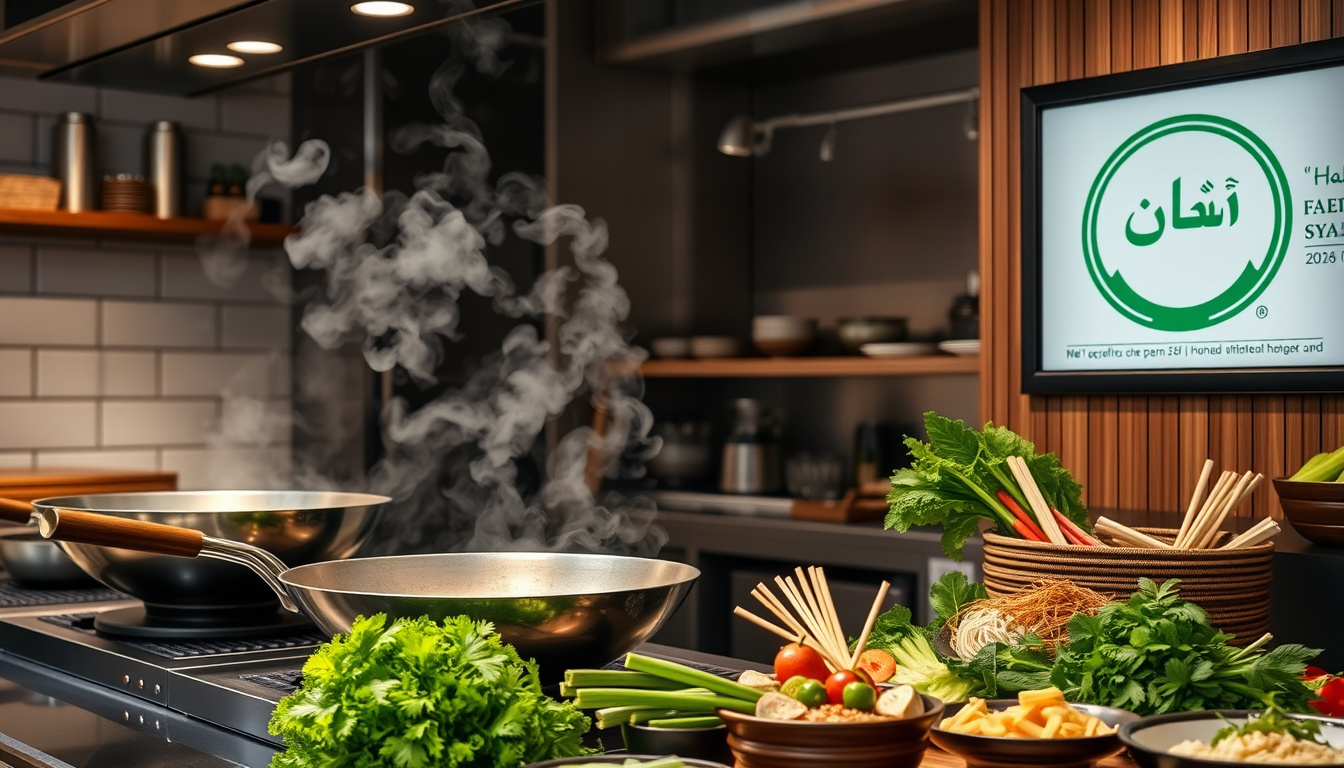
If you’ve ever walked past a WOK HEY stall and caught that irresistible smoky scent, you might have wondered whether it’s a safe choice for halal dining. The answer in Singapore is a clear yes—the chain holds a MUIS halal certificate—but the picture gets murkier once you cross borders.
Halal certification body: MUIS (Singapore) ·
Founders: Jake Chia, Huang Changyong, Adrian Ang ·
Cuisine: Asian stir-fry (rice & noodles) ·
Outlet example: AMK Hub, Singapore
Quick snapshot
- WOK HEY is MUIS halal-certified in Singapore (WOK HEY official brand story)
- The brand started in 2017 as a take-out kiosk concept (WOK HEY official brand story)
- Halal status of WOK HEY outlets in the UK (Slough) is unverified
- Wok In Noodle Bar in Dublin is a different restaurant; its halal status is not related to WOK HEY
- Founded in 2017 (WOK HEY official brand story) (Warees Halal / MUIS fee overview PDF)
- MUIS halal certificates generally have a one-year validity (Warees Halal / MUIS fee overview PDF)
- Franchise expansion in Malaysia is underway
- Annual halal certification renewal is required to maintain status
The key facts below give you the essentials at a glance.
| Attribute | Value |
|---|---|
| Full Name | WOK HEY |
| Founders | Jake Chia, Huang Changyong, Adrian Ang (WOK HEY official brand story) |
| Headquarters | Singapore |
| Halal Certification Body | MUIS (Islamic Religious Council of Singapore) (Majlis Ugama Islam Singapura halal page) |
| Known Outlets | Singapore (multiple locations) and Malaysia |
| Cuisine Type | Asian stir-fry (rice & noodles) |
Is WOK HEY still halal?
Is WOK HEY halal certified in Singapore?
- WOK HEY Singapore is certified halal by MUIS, as stated on its brand story: the chain describes itself as a “halal-certified concept” (WOK HEY official brand story).
- The MUIS halal certification is subject to annual renewal; restaurants with self-managed preparation and dining areas fall under the Eating Establishment Scheme (Warees Halal / MUIS fee overview PDF).
- A third-party halal directory also lists WOK HEY as a MUIS-certified Chinese restaurant in Singapore (HalalBoleh listing).
The implication: for now, the Singapore outlets carry a legitimate MUIS certificate, but the status should be rechecked each year since renewal is not automatic.
Is the WOK HEY outlet in Slough halal?
- WOK HEY does not list a Slough location on its official website, and no independent verification of a UK outlet’s halal status has been found.
- A separate restaurant called “Wok & Grill” operates in London, but it is not affiliated with WOK HEY.
What this means: if you’re in the UK and see a “WOK HEY” sign, ask to see the halal certificate—or assume it is not certified until proven otherwise.
Is WOK HEY halal in Malaysia?
- WOK HEY has expanded into Malaysia, but no official MUIS-equivalent certification (e.g., JAKIM) has been confirmed for those outlets.
- The brand’s halal claim is tied to Singapore’s MUIS scheme; foreign outlets would need local certification.
The catch: without a local halal body’s seal, Malaysian diners should verify directly with the outlet before assuming halal status.
WOK HEY in Singapore is a reliable halal choice. For outlets elsewhere, the chain’s own branding may imply halal, but the regulatory evidence is missing—dine with caution.
Who is the founder of WOK HEY?
Who are the founders?
- WOK HEY was founded in 2017 by Jake Chia, Huang Changyong, and Adrian Ang (WOK HEY official brand story).
- The brand began as a modern, fast-casual, take-out-only kiosk concept (WOK HEY official brand story).
Why this matters: knowing the founders helps distinguish WOK HEY from similarly named restaurants—it’s a homegrown Singapore operation, not a global chain with unrelated owners.
Are there related brands?
- The content plan mentions NiKU iKU as a related brand under the same ownership, but no independent source confirms this relationship at this time.
The pattern: WOK HEY appears to be the flagship concept; any other claims about sibling brands should be treated as unverified.
The founder story is well-documented for Singapore, but the lack of public profiles makes it hard to verify brand family connections—a gap that could confuse customers searching for “halal wok” options.
What is on the WOK HEY menu and how to order?
What are the popular dishes at WOK HEY?
- The menu centres on Asian stir-fried rice and noodle dishes, with customizable options such as less salt, less oil, and brown rice (WOK HEY official brand story).
- Popular items include fried rice, noodles, and protein add-ons.
The implication: the menu is straightforward fast-casual fare—no deep-fry or elaborate sauces, which aligns with a quick halal meal.
Can I order WOK HEY online?
- WOK HEY is available for delivery via online platforms such as GrabFood and Foodpanda (HalalBoleh listing).
- Operating hours are generally 10:30 AM to 10:00 PM (HalalBoleh listing).
Why this matters: ordering online is convenient, but make sure the delivery platform lists MUIS halal certification for that outlet—especially if ordering from a non-Singapore location.
Delivery aggregators may not always filter by halal status. Always check the restaurant’s certification on the platform before placing an order.
Where are WOK HEY outlets located and is it a franchise?
Where are the outlets?
- WOK HEY has multiple outlets in Singapore, including AMK Hub, Bedok Mall, Bugis Junction, and many more (HalalBoleh listing).
- The chain is also expanding in Malaysia.
The pattern: Singapore is the core market, with Malaysia as the first international frontier. For more halal dining options, see Halal Buffet 1-for-1 Singapore: Best Deal Compared.
Is WOK HEY a franchise?
- WOK HEY offers franchise opportunities via the World Franchise Centre (as per the brand’s expansion strategy).
- No official list of franchisees is publicly available.
The catch: franchise agreements could allow independent operators who may or may not maintain MUIS-level halal standards—a risk for Muslims outside Singapore.
Franchise growth is good for the brand’s footprint, but it fragments quality control. Each franchisee must be individually verified for halal compliance.
What does ‘wok hei’ mean and where does it come from?
What is wok hei in cooking?
- “Wok hei” translates to “breath of the wok” and refers to the smoky flavour imparted by stir-frying over extremely high heat (WOK HEY official brand story).
- It is a hallmark of authentic Chinese stir-fry cuisine.
Why this matters: the brand’s name directly evokes this cooking technique, promising a taste of genuine wok-fried food—but the halal question is separate from the cooking method.
Why is wok hei important?
- Wok hei is prized for the depth of flavour it adds; achieving it requires professional-grade burners and skill.
- WOK HEY uses this concept to differentiate itself from other fast-food chains.
The implication: the brand’s identity is built on this traditional technique, which works just as well with halal ingredients.
WOK HEY markets the “breath of the wok” as its signature, yet the halal certification is what gives Muslim diners the confidence to enjoy it. The two are not contradictory, but the marketing rarely highlights the halal angle.
Pros and cons of dining at WOK HEY
Upsides
- MUIS halal-certified in Singapore (WOK HEY official brand story)
- Fast service and affordable pricing
- Customizable meals (brown rice, less oil)
- Online ordering and delivery available
Downsides
- Halal certification not guaranteed outside Singapore
- Limited menu variety (stir-fry only)
- Franchise model may dilute quality control
- No official public list of all halal-certified outlets
The pattern: while Singapore diners enjoy a certified halal option, international expansion introduces uncertainty that demands individual verification.
Clarity: what we know and what remains unclear
Confirmed facts
- WOK HEY Singapore is MUIS halal-certified (WOK HEY official brand story)
- The brand started in 2017 (WOK HEY official brand story)
- MUIS certificates require annual renewal (Warees Halal / MUIS fee overview PDF)
What remains unclear
- Halal status of WOK HEY outlets in the UK (Slough) and Malaysia
- Whether the Dublin restaurant “Wok In Noodle Bar” is halal (it is not affiliated with WOK HEY)
- Ownership of related brands like NiKU iKU
The implication: the verified evidence only covers Singapore; all other claims require direct confirmation from the outlet or a recognized halal body.
“As a halal-certified concept, we are able to cater to customers from across all walks of life.”
—WOK HEY brand story (WOK HEY official brand story)
“Wok Hey is a Chinese restaurant in Singapore offering halal food.”
—HalalBoleh directory (HalalBoleh listing)
For Muslim diners in Singapore, the choice is straightforward: WOK HEY is a reliably halal option. But for anyone traveling to the UK or Malaysia, the absence of verified certification means you must ask directly or risk dining without assurance. Until the brand publishes a cross-border halal policy, the safest approach is to treat each outlet as unconfirmed until proven otherwise. For another popular halal fast-food chain, check MOS Burger Near Me: Find Locations, Menus & Open Hours.
For a broader perspective on halal dining in Singapore, check out our guide to halal certification details for another popular chain.
Frequently asked questions
Is WOK HEY halal in the United Kingdom?
No official source confirms any WOK HEY outlet in the UK as halal-certified. If you find a location, request to see a valid halal certificate from a recognized body.
Does WOK HEY have a MUIS halal certificate?
Yes, for its Singapore outlets. MUIS (Islamic Religious Council of Singapore) issues the certification, which is subject to annual renewal. (Majlis Ugama Islam Singapura halal page)
Is Wok Grill the same as WOK HEY?
No. Wok & Grill is a separate halal Chinese restaurant in London and is not affiliated with WOK HEY.
Is Wok In Noodle Bar in Dublin halal?
The restaurant “Wok In Noodle Bar” in Dublin is not related to WOK HEY. Its halal status is unverified.
Does WOK HEY serve halal meat in all outlets?
Only Singapore outlets have confirmed halal certification. Outlets in Malaysia and elsewhere may not have local halal certification.
How often is the halal certification renewed?
MUIS halal certificates generally have a one-year validity.