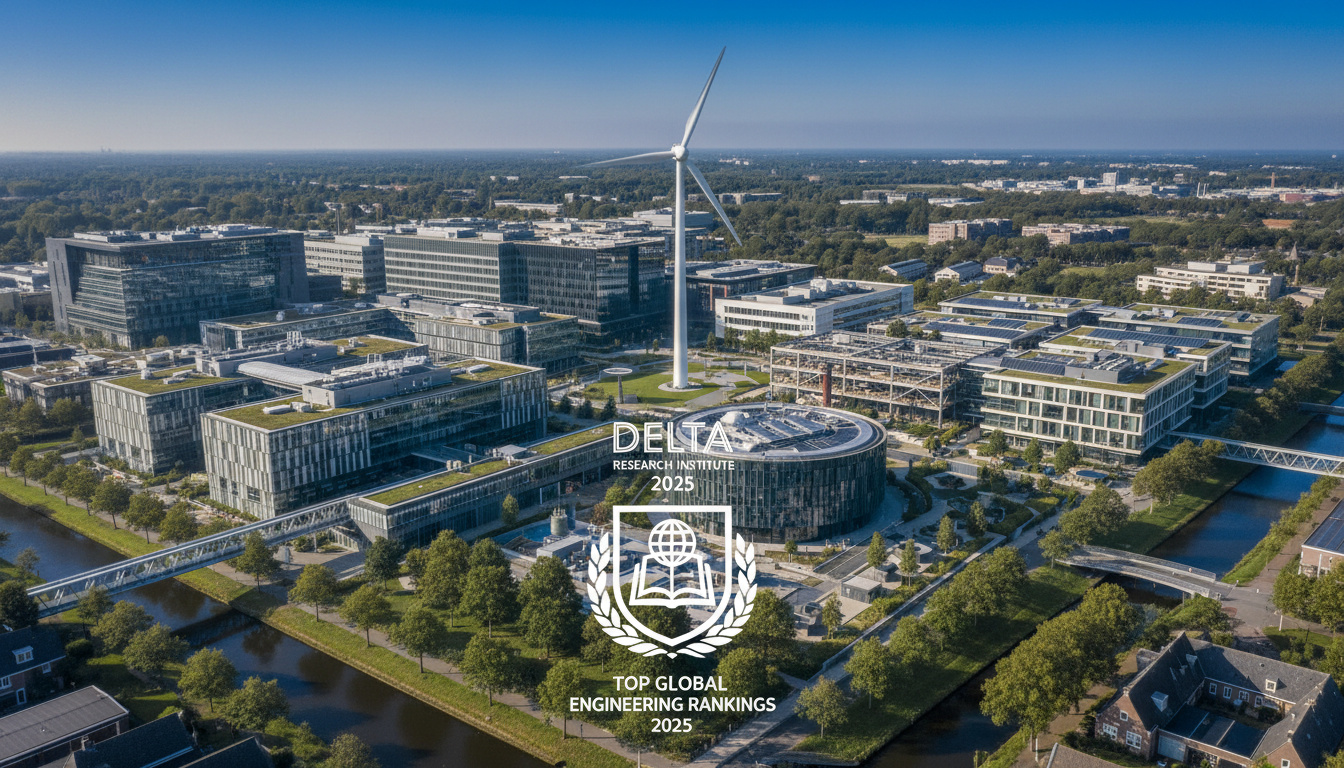
Delft University of Technology stands as the Netherlands’ largest and oldest public technical university, commanding global recognition for engineering excellence. Located in the historic city of Delft, the institution attracts approximately 27,000 students from across the world, with international learners comprising 35% of the student body.
Founded on a 180-year tradition of civil engineering education, TU Delft has evolved into a comprehensive research powerhouse spanning eight faculties and 40 departments. The university consistently ranks among the top 50 institutions worldwide, with particular dominance in aerospace, civil engineering, and water resource management disciplines.
The campus integrates science and engineering faculties with extensive laboratory facilities, positioning the Faculty of Industrial Design Engineering at its geographic and academic heart. This architectural layout reflects the institution’s commitment to merging theoretical knowledge with practical application across 55 undergraduate and postgraduate programs.
What is Delft University of Technology?
- Engineering dominance: Ranked #3 globally for Transportation Science & Technology and #10 for Aerospace Engineering in 2025 subject rankings.
- International profile: Holds the #14 position globally for most international universities, with students from over 100 countries.
- Research scale: Operates across 8 faculties and 40 departments with an annual budget exceeding €1 billion.
- Sustainability leadership: Achieved #1 in THE Impact Rankings for UN Sustainable Development Goal 9 (Industry, Innovation, and Infrastructure).
- Program breadth: Offers 55 distinct bachelor’s and master’s programs spanning traditional and emerging engineering fields.
- Historical depth: Maintains a 180-year continuous tradition in technical education since its establishment as a civil engineering school.
- Strategic location: Situated in the technological hub of Delft, providing proximity to Dutch research institutes and engineering firms.
| Fact | Details | Source |
|---|---|---|
| Total Enrollment | ~27,000 students | QS World University Rankings |
| International Students | 35% of total enrollment | TU Delft Official Rankings |
| Faculties | 8 academic faculties | QS University Profile |
| Departments | 40 research departments | Institutional Data |
| QS World Ranking 2026 | #47 globally | QS Rankings 2026 |
| THE World Ranking 2026 | #57 globally | Delta TU Delft |
| Subject Programs | 55 bachelor’s and master’s | University Profile |
| Location | Delft, South Holland, Netherlands | THE Profile |
What are TU Delft’s rankings and reputation?
TU Delft maintains a formidable position in global higher education, ranking #47 in the QS World University Rankings 2026 and #57 in the Times Higher Education World University Rankings 2026. The institution demonstrates particular strength in Western Europe, securing the #4 position in regional QS rankings.
Global and subject rankings
The university’s composite rankings reflect consistent excellence across multiple evaluation frameworks. While QS places the institution at #47 globally, Times Higher Education positions it at #57 (a slight decrease from #56 the previous year). The Academic Ranking of World Universities (ARWU) 2025 lists TU Delft in the #151-200 bracket, while US News ranks it #191 globally.
Subject-specific rankings reveal TU Delft’s engineering core. Transportation Science & Technology ranks #3 worldwide, followed by Environmental Sciences at #7 and Water Resources at #9. Aerospace Engineering holds the #10 position globally, while Industrial Design Engineering ranks #11 in QS Art & Design categories. Additional top-20 placements include Marine/Ocean Engineering (#12), Civil Engineering (#16), Robotic Science & Engineering (#18), and Mechanical Engineering (#22).
TU Delft leads global rankings in Architecture, Civil & Structural Engineering, and Water Resources according to QS and THE subject evaluations. The Faculty of Industrial Design Engineering specifically achieved 11th position globally in the 2025 QS Art & Design Rankings.
Reputation signals
Beyond traditional rankings, TU Delft demonstrates significant impact in sustainability and internationalization metrics. The institution ranks #1 globally in THE Impact Rankings for UN Sustainable Development Goal 9, which measures industry, innovation, and infrastructure development. It also places #28 for SDG 7 (Clean Energy) and maintains the #14 position worldwide for international outlook.
The student body composition reinforces this international reputation, with 35% of enrolled students coming from outside the Netherlands. This demographic diversity supports the university’s mission to address global engineering challenges through multicultural collaboration.
What programs and faculties does TU Delft offer?
TU Delft delivers 55 undergraduate and postgraduate programs distributed across eight faculties, emphasizing engineering sciences while incorporating design and technology policy disciplines. The curriculum spans traditional fields like civil and mechanical engineering alongside emerging domains including robotics and sustainable energy systems.
Undergraduate and graduate programs
The academic portfolio encompasses bachelor’s degrees requiring three years of study and master’s programs typically lasting two years. Engineering sciences dominate the offerings, with specialized tracks in aerospace engineering, civil engineering, mechanical engineering, and marine technology. Emerging interdisciplinary programs address robotics, artificial intelligence, and climate adaptation engineering.
Research integration characterizes the graduate-level experience, with master’s students participating in ongoing projects across 40 departments. This structure aligns with the university’s classification as a research-intensive technical institution focused on addressing contemporary infrastructure and technological challenges.
Key faculties
Eight faculties organize the university’s academic activities: Aerospace Engineering; Architecture and the Built Environment; Civil Engineering and Geosciences; Electrical Engineering, Mathematics and Computer Science; Industrial Design Engineering; Mechanical, Maritime and Materials Engineering; Technology, Policy and Management; and Applied Sciences.
The Faculty of Industrial Design Engineering occupies a central campus position, reflecting its integrative role connecting technical engineering with human-centered design principles. This faculty achieved notable recognition in 2025, securing the #11 global ranking in QS Art & Design categories.
For students considering academic calendars at comparable institutions, the Polytechnic School Holidays 2025 – Confirmed Dates and Gaps provides relevant scheduling context for technical education programs.
How to get admitted to TU Delft?
Admission to TU Delft remains highly competitive, reflecting the institution’s top-tier global rankings and limited capacity within specialized engineering tracks. The university maintains selective standards particularly for international applicants seeking positions in high-demand fields like aerospace and robotics.
Application process
Specific step-by-step application procedures vary by program and applicant nationality, requiring consultation of the official TU Delft admissions portal. Generally, applications require demonstrated proficiency in mathematics and physics at the secondary level, standardized test scores where applicable, and proof of English language competency for non-native speakers.
Engineering programs typically require additional subject-specific prerequisites, while design-oriented tracks may request portfolio submissions. Application deadlines differ between EU and non-EU residents, with most programs accepting submissions through the centralized Studielink platform supplemented by institutional documentation.
Acceptance rate and fees
No specific acceptance rate data appears in available institutional disclosures, though the combination of top-50 global rankings and a fixed enrollment capacity of approximately 27,000 students suggests significant selectivity. Prospective applicants should prepare competitive academic profiles featuring advanced mathematics and science credentials.
Tuition fees vary substantially based on nationality and program type. Annual statutory fees apply to EU/EEA students, while non-EU applicants face higher institutional rates. Exact figures require verification through the university’s official financial services portal, as rates undergo periodic revision. Additional costs include living expenses in the Delft municipality, laboratory fees for certain engineering tracks, and mandatory health insurance for international students.
Applicants must verify current tuition rates and specific entry requirements directly through tudelft.nl, as fees and prerequisites vary by program and nationality. The university does not publish standardized acceptance rates, suggesting variable competitiveness across faculties.
While specific tuition figures are not available in current institutional summaries, prospective students should budget for differential fee structures between EU and non-EU classifications, plus significant living costs in the Dutch Randstad region. For a comprehensive overview of the university’s offerings and admissions, consult the ${Honor Magic 6 Pro arvostelu}. Honor Magic 6 Pro arvostelu
How has TU Delft evolved since its founding?
The institution’s development reflects the industrial and technological transformation of the Netherlands over two centuries. From its origins training civil engineers for national infrastructure projects, TU Delft has expanded into a comprehensive technical university addressing space exploration, quantum computing, and sustainable energy systems.
-
Founded as a polytechnic school focused on civil engineering education, establishing the foundation for Dutch technical higher education.
-
Received royal charter status, elevating the institution’s standing and expanding its mandate to grant engineering degrees.
-
Achieved full university status, transitioning from a technical college to a comprehensive research university with doctoral programs.
-
Established the Delft Space Institute and expanded quantum technology research, leveraging 180 years of engineering tradition.
-
Achieved #47 in QS World Rankings and top-10 global positions in multiple engineering subjects, maintaining leadership in aerospace and water management.
What is confirmed and what remains unclear about TU Delft?
Established Facts
- QS World Ranking #47 and THE Ranking #57 for 2025-2026
- 35% international student composition
- 55 undergraduate and postgraduate programs available
- 8 faculties and 40 departments operational
- #1 global ranking for THE Impact SDG 9
- Founded 1842 with continuous operation since
- Subject rankings: Transportation (#3), Aerospace (#10), Civil (#16)
Information Gaps
- Specific annual acceptance rates by faculty
- Exact tuition figures for 2025-2026 academic year
- Detailed admissions statistics for international applicants
- Comprehensive list of notable alumni achievements
- Specific campus housing availability and costs
How does TU Delft fit into the Dutch higher education landscape?
As the Netherlands’ largest technical university, TU Delft occupies a unique position distinct from comprehensive research universities like University of Amsterdam or Leiden University. While traditional Dutch universities emphasize humanities and social sciences alongside science, TU Delft maintains exclusive focus on engineering, technology, and design disciplines.
This specialization generates close partnerships with Dutch industry, particularly in maritime engineering, water management, and architectural design—fields where Dutch expertise holds global leadership. The university’s proximity to The Hague and Rotterdam facilitates collaboration with international tribunals, port authorities, and multinational engineering firms headquartered in the Randstad metropolitan region.
The institution’s engineering legacy parallels other European technical universities like ETH Zurich and RWTH Aachen, though TU Delft distinguishes itself through specific strengths in delta technology and water resource management reflecting the Netherlands’ geographic challenges. For comparison of global institutional legacies, the Seven Wonders of the World – Ancient vs New Lists and Survivors illustrates how historical and modern evaluations of excellence differ across contexts.
What sources verify TU Delft’s academic standing?
Multiple independent ranking organizations corroborate TU Delft’s position in global higher education. QS World University Rankings, Times Higher Education, and the Academic Ranking of World Universities utilize distinct methodologies spanning research output, international collaboration, and teaching reputation.
TU Delft maintains a strong position in international rankings, particularly in QS and THE, placing it near the top 50 worldwide, top 20 in Europe, and top 3 in the Netherlands.
— TU Delft International Rankings Report, 2025-2026
The university shows stable or upward trends over recent years across QS, THE, and ARWU, with particular excellence in engineering and technology subjects often placing in the global top 20.
— Institutional Rankings Analysis, Delta TU Delft
Subject-specific evaluations from QS confirm top-20 global positions for Transportation Science, Environmental Sciences, Water Resources, and Aerospace Engineering. These assessments rely on academic reputation surveys, employer feedback, and citation metrics from Scopus-indexed publications.
What defines TU Delft in 2025?
Delft University of Technology represents the convergence of historical engineering tradition and contemporary technological innovation, ranking #47 globally while maintaining specialized dominance in aerospace, civil engineering, and water resource management. With 27,000 students—35% international—distributed across eight faculties, the institution continues its 180-year mission of addressing infrastructural and technological challenges through research-intensive education. As admissions remain competitive and specifics regarding acceptance rates and tuition require direct institutional consultation, prospective students should prepare rigorous applications emphasizing mathematical and scientific excellence. For those navigating the technical education landscape, understanding institutional timelines like those in the Polytechnic School Holidays 2025 – Confirmed Dates and Gaps helps contextualize the academic rhythm at leading engineering universities.
Frequently asked questions
What is the difference between TU Delft and other Dutch universities?
TU Delft specializes exclusively in engineering and technology, unlike comprehensive Dutch universities such as University of Amsterdam or Utrecht University which include extensive humanities and social science programs. It is the Netherlands’ largest technical university with specific strength in aerospace, civil engineering, and water management.
Does TU Delft offer online programs?
Information regarding comprehensive online degree programs remains limited. TU Delft traditionally emphasizes laboratory-based engineering education requiring physical campus presence, particularly for disciplines like aerospace and mechanical engineering.
What scholarships are available at TU Delft?
Detailed information on specific