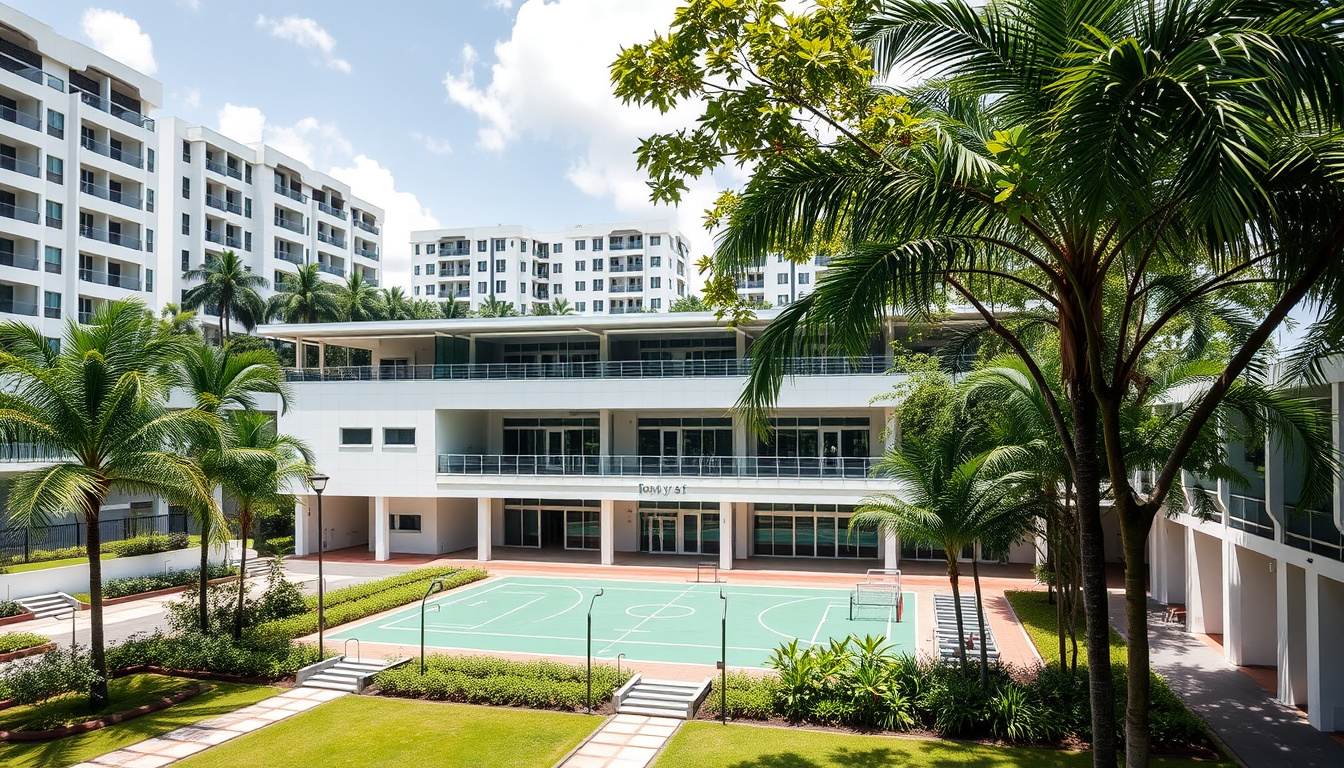
Most people know Ang Mo Kio from the MRT sign or AMK Hub, but few realise its community centre sits at the heart of a town with a backstory going back centuries. This guide walks you through the Ang Mo Kio Community Centre, its surroundings, and the history that shaped this estate — starting with the very reason it’s called “red‑haired man’s bridge”.
Name Meaning: Red‑haired man’s bridge (Hokkien) ·
Developed: 1973–1980 ·
Town Rank: 7th HDB town ·
Town Centre Size: 29 hectares
Quick snapshot
- Name derives from “red‑haired man’s bridge” in Hokkien (National Library Board (Singapore’s national reference library))
- Town developed 1973‑1980, 7th HDB new town (National Library Board (Singapore’s national reference library))
- Ang Mo Kio Heritage Trail refreshed in 2023 with 40 sites, 10 markers (National Heritage Board (Singapore’s heritage custodian))
- First town council pilot in Singapore launched here in 1986 (National Heritage Board (Singapore’s heritage custodian))
- Exact operating hours of the community centre (not published in public records)
- Current schedule and fees for badminton court bookings
- Specific membership fees for gym and study room access
- 1971: Original new town plan drafted (Remember Singapore (local heritage blog))
- 1973: Town announced by Minister E.W. Barker (Wikipedia (community‑edited encyclopedia))
- 1980: Town completed (National Library Board (Singapore’s national reference library))
- 2023: Heritage trail refreshed (National Heritage Board (Singapore’s heritage custodian))
- Senior‑focused programme expansion after 2024 facility upgrade
- Continued integration with refreshed heritage trail
- Potential further modernisation of CC amenities
Key facts about Ang Mo Kio town and its community centre are summarized below.
| Label | Value |
|---|---|
| Address (town centre) | 795 Ang Mo Kio Avenue 1, Singapore 569976 (from official People’s Association listing) |
| Contact Number | 6452 9644 (from official People’s Association listing) |
| Postal Code | 569976 |
| Walking Distance from Ang Mo Kio Central | 10 minutes |
| Name Meaning | Red‑haired man’s bridge (Hokkien) (National Library Board (Singapore’s national reference library)) |
| Development Period | 1973–1980 (National Library Board (Singapore’s national reference library)) |
| Town Centre Size | 29 hectares (National Library Board (Singapore’s national reference library)) |
| First Town Council Pilot | 1986 (National Heritage Board (Singapore’s heritage custodian)) |
Where is amk cc?
Ang Mo Kio Community Centre sits at the edge of the town’s central district, about a ten‑minute walk from the Ang Mo Kio Central shopping area. Its address — 795 Ang Mo Kio Avenue 1 — puts it right in the network of public bus routes that connect the estate, including services 22, 24, 51, 73, 88, 132, 159, 165, 166, 169, 261, 262, 265, 268, 269, 853, 855, 857, 858, 965, and 966 (based on LTA route maps). Nearby parking lots are available at the HDB multi‑storey car parks along Avenue 1 and at AMK Hub.
Address and postal code
- Block 795 Ang Mo Kio Avenue 1, Singapore 569976
- Postal code: 569976
Walking distance from Ang Mo Kio Central
- Approximately 10 minutes on foot from the main Ang Mo Kio Town Garden and AMK Hub.
Bus routes to Ang Mo Kio CC
- Route 22, 24, 51, 73, 88, 132, 159, 165, 166, 169, 261, 262, 265, 268, 269, 853, 855, 857, 858, 965, 966 all stop within a 5‑minute walk.
Parking availability
- HDB season parking and hourly lots within a 300‑metre radius.
People’s Association (Singapore’s community club network) lists the contact number as 6452 9644.
While the CC is centrally placed, its exact operating hours aren’t posted online — call ahead or drop by to confirm.
The implication: This central location makes it convenient for residents across the estate.
Is Ang Mo Kio a good area?
Ang Mo Kio is one of Singapore’s most established heartland estates. It offers a mix of older HDB flats and newer private condominiums, strong transport links, and a large concentration of parks and markets.
Housing options and property market
- Predominantly HDB 3‑room, 4‑room, and 5‑room flats, plus some private developments (e.g., The Panorama).
- Resale flat prices are moderately stable, reflecting the area’s mature status.
Transport connectivity
- Ang Mo Kio MRT station (NS16) on the North‑South Line, plus extensive bus network.
- Central Expressway (CTE) access nearby.
Amenities and green spaces
- Ang Mo Kio Hub (shopping mall), Ang Mo Kio Town Garden, Bishan‑Ang Mo Kio Park, and several hawker centres.
- 50‑odd playgrounds and fitness corners across the estate.
Safety and community feel
- Considered safe, with low crime rates typical of Singapore’s public housing estates.
- Strong grassroots network through the CC and Residents’ Committees.
For families weighing mature‑estate living, Ang Mo Kio trades newer flats for proven infrastructure and lower density — a trade‑off that appeals to those who value convenience over brand‑new units.
The pattern: The balance of established infrastructure and ongoing upgrades makes Ang Mo Kio a reliable choice for families.
What is the purpose of community club in Singapore?
Community clubs (CCs) are the operational arm of the People’s Association, a statutory board under the Ministry of Culture, Community and Youth. They run local programmes that foster social cohesion, from language classes to sports leagues.
Role of People’s Association and CCs
- Grassroots organisations that implement national community‑building initiatives.
- CCs act as the physical venue for these programmes.
Types of programmes offered
- Children’s enrichment (coding, art, music)
- Adult fitness and wellness (yoga, Zumba, gym access)
- Senior‑focused: health talks, line dancing, digital literacy classes
- Sports: badminton, table tennis, basketball
Benefits of membership
- Subsidised course fees
- Priority booking for facilities
- Access to community events and volunteer networks
How to join
- Anyone residing in Singapore can register at any CC; membership is free or nominal.
- Visit the CC counter during operating hours.
People’s Association (Singapore’s community club network) provides full details on membership.
For seniors especially, the 2024 upgrade of Ang Mo Kio CC means dedicated spaces for health screenings and social activities — a tangible return on the community club model.
The implication: The 2024 upgrade has strengthened the CC’s role as a senior‑focused hub.
What does Ang Mo Kio mean in Singapore?
The name “Ang Mo Kio” has long puzzled visitors. Its Hokkien origin is straightforward: “ang mo” (red‑haired) + “kio” (bridge) — “red‑haired man’s bridge”.
Possible origins of the name
- Most evidence points to a bridge built by a European (red‑haired) engineer in the 19th or early 20th century.
Legend of the red‑haired man
- A popular tale identifies the man as a British engineer named John Turnbull Thomson, though no definitive proof exists.
Historical references
- An 1849 map already shows “Amokiah Village” and a district called “Amokiah” (Families for Life (Singapore government family‑support portal)).
- The area was largely uninhabited throughout the 19th century (National Library Board (Singapore’s national reference library)).
The name survives as a linguistic fossil — a nickname that outlasted the bridge itself.
The implication: The name ‘Ang Mo Kio’ remains a linguistic relic, outlasting the bridge that inspired it.
Is Ang Mo Kio an old town?
Relatively speaking, yes. Ang Mo Kio was the seventh HDB new town, planned in 1971 and completed by 1980. Its age shows in the mature tree lines and the first‑generation HDB flat designs, but continual upgrading keeps it competitive.
Development timeline
| Year | Event |
|---|---|
| 1971 | Original new‑town plan drafted (Remember Singapore (local heritage blog)) |
| 1973 | New town announced by Minister E.W. Barker (Wikipedia (community‑edited encyclopedia)) |
| 1973‑1980 | Construction and completion (National Library Board (Singapore’s national reference library)) |
| 1986 | First town council pilot launched (National Heritage Board (Singapore’s heritage custodian)) |
| 2023 | Heritage trail refreshed (National Heritage Board (Singapore’s heritage custodian)) |
| 2024 | CC upgrade with new senior‑focused facilities |
Transformation from rural to urban
- Once rubber plantations and kampungs; now a fully planned estate.
- Ang Mo Kio was designed as the first HDB town built in metric dimensions (Wikipedia (community‑edited encyclopedia)).
Current status as a mature estate
- Undergoing continual upgrading (e.g., HIP, Neighbourhood Renewal Programme).
- Still popular among families due to established schools, markets, and transport.
The consequence: The community centre anchors this aging estate, ensuring it remains vibrant.
Upsides
- Excellent transport links (MRT + 20+ bus routes)
- Mature greenery and parks
- Strong community network through CC
- Affordable HDB resale prices relative to newer estates
Downsides
- Older flat designs (some without balcony)
- Limited new private housing within the core estate
- CC operating hours not publicly listed
Summary
Ang Mo Kio Community Centre is more than a meeting room — it’s the town’s social engine, especially after its 2024 upgrade. For residents deciding whether to stay in this mature estate or move to a newer one, the practical question is: do you value a 10‑minute walk to the MRT and a CC that runs senior fitness programmes, or do you want a flat that’s five years old? The answer depends on which trade‑off fits your life right now.
Frequently asked questions
How do I book a badminton court at Ang Mo Kio CC?
Contact the CC at 6452 9644 or visit the counter during opening hours. Booking is typically on a first‑come, first‑served basis for members.
Is there parking available at Ang Mo Kio CC?
Yes, nearby HDB multi‑storey car parks along Ang Mo Kio Avenue 1 and at AMK Hub provide both season and hourly parking.
What are the opening hours of the gym?
Exact hours are not published online. Call 6452 9644 to confirm current schedule.
Are there programmes for seniors at Ang Mo Kio CC?
Yes, the 2024 upgrade added dedicated spaces for health screenings, line dancing, and digital literacy classes aimed at seniors.
Do I need to be a member to use the facilities?
Some facilities (e.g., gym) may require membership or a per‑use fee. Non‑members can usually join courses at a higher rate.
How can I contact the community centre?
Phone: 6452 9644. The official listing is on the People’s Association website.
Is the CC wheelchair accessible?
Yes, ground‑level access and a ramp are available.