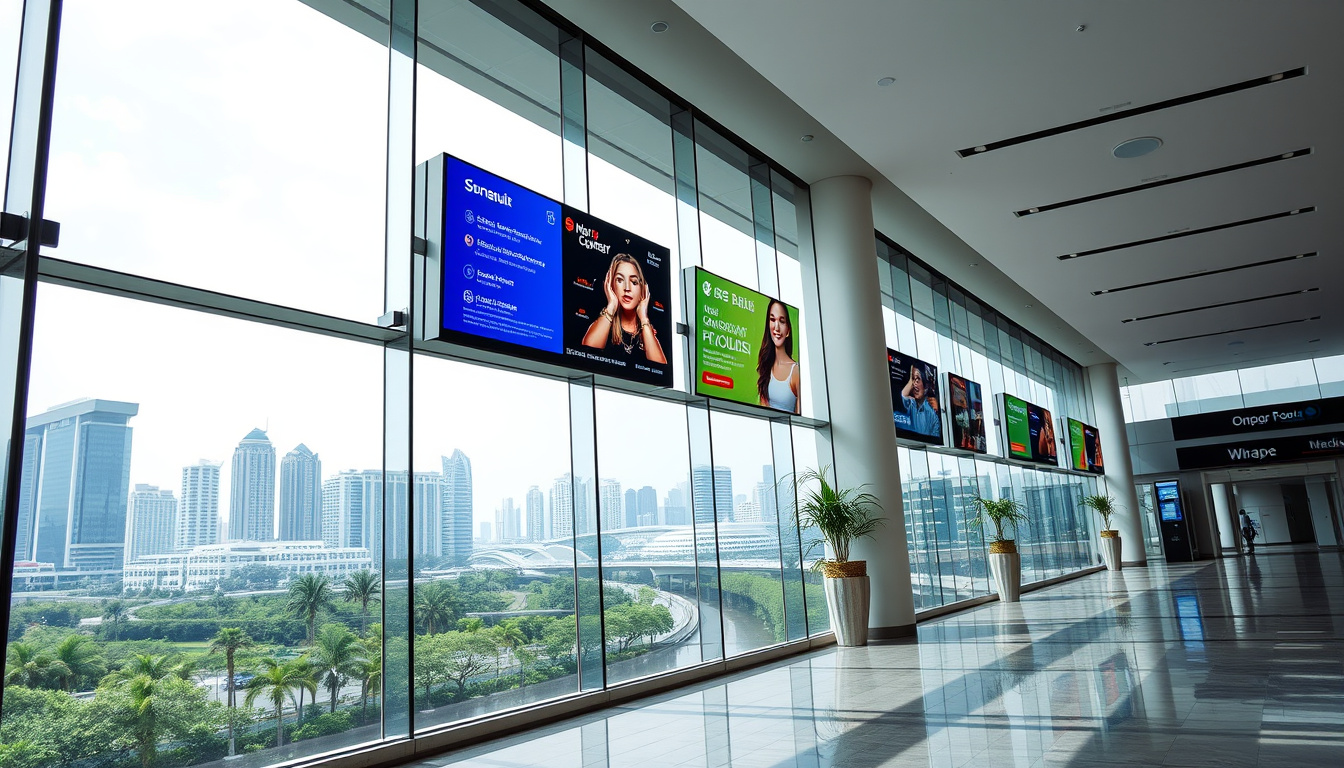
Anyone who has walked through a Singapore mall or office lobby recently has noticed the shift — static posters are giving way to bright digital screens that refresh content in seconds, but choosing the right digital signage solution for your business is not as simple as picking a screen off the shelf. According to EasySignage’s 2025 pricing guide, a basic setup can start as low as $100 while enterprise solutions can exceed $5,000 per screen.
Market leader: Samsung (Samsung corporate site) · Providers in Singapore: KOO, Zoom Visual, Fugo, LG, Samsung (Look Digital Signage directory) · Screen sizes: 43 to 86 inches (Fugo buyer’s guide)
Quick snapshot
- Samsung is ranked the #1 global digital signage provider (Samsung official site)
- KOO Digital Signage operates in Singapore with indoor/outdoor offerings (KOO Digital Signage)
- LG offers digital signage products available in Singapore (LG official site)
- Exact average price for a complete digital signage solution in Singapore
- Actual ROI numbers for Singapore SMEs
- Market share breakdown of local integrators vs global brands
- Singapore digital signage software market expected to grow through 2031 (6Wresearch market outlook)
- Buying guides and provider lists published in 2025 show active market (Fugo Singapore guide) (6Wresearch market outlook)
- More providers offering transparent per-screen pricing instead of enterprise quotes (Fugo comparison)
- SaaS-based subscriptions likely to dominate SMB adoption in Singapore
Five providers, one pattern: the market splits between global hardware giants and local integrators, with different trade-offs for each.
| Provider | Type | Pricing model | Best suited for |
|---|---|---|---|
| Samsung | Global hardware + software | Enterprise quote required | Large retail chains, corporate headquarters |
| LG | Global hardware + software | Enterprise quote required | Indoor and outdoor deployments |
| KOO Digital Signage | Singapore local integrator | Project-based pricing | Indoor/outdoor, custom installations |
| Fugo | Cloud software platform | Per-screen subscription | SMEs, multi-location businesses |
| Zoom Visual Pte Ltd | Singapore local integrator | Project-based pricing | Retail, corporate, events |
The trade-off: global brands bring reliability and scale but require sales conversations for pricing, while local integrators offer faster on-the-ground support and custom quotes that match Singapore’s specific installation environments.
What is a digital signage solution?
A digital signage solution combines display hardware, media players, and content management software to show dynamic media in public or private spaces. Unlike static posters or printed signs, digital signage lets you update content remotely, schedule playlists, and even trigger changes based on time of day or audience data.
Components of a digital signage system
- Display screens: LCD, LED, or projection panels ranging from 43 to 86 inches (Fugo buyer’s guide)
- Media players: Small computers that decode and push content to screens
- Content management software (CMS): Cloud or on-premise platform for creating and scheduling content
- Mounting and accessories: Brackets, cables, enclosures for indoor or outdoor installation
Software vs hardware roles
- Hardware handles display and playback; software manages content and scheduling
- Some providers like Samsung offer integrated hardware-software stacks (Samsung corporate digital signage)
- Cloud-based CMS platforms such as Fugo and OptiSigns work across multiple hardware brands (SoftwareSuggest Singapore directory)
- Local Singapore integrators like KOO bundle hardware, installation, and software in one project quote (KOO Digital Signage)
Digital signage covers a broad range of applications — from a single screen in a coffee shop to a multi-screen video wall in a shopping centre. What links them all is the ability to change content without touching the screen.
A digital signage solution is not a single product but a system. Buying a screen without the software layer is like buying a smartphone with no operating system — the hardware alone does not deliver the value.
The implication: choosing your software platform first often makes more sense than choosing the screen first, because the CMS determines what you can actually do with the system day to day.
How does digital signage work?
Digital signage works through a straightforward pipeline: content is created on a CMS, sent over a network to media players, and displayed on screens. The key is that each step can be managed remotely, which is what makes digital signage far more flexible than static alternatives.
Content creation and scheduling
- Content — images, video, live feeds, social media widgets — is built inside a CMS dashboard
- Playlists and schedules determine what appears when, down to the minute
- Updates happen in real time; no physical intervention needed (PosterBooking digital signage overview)
Network and connectivity options
- Screens connect via Wi-Fi, Ethernet, or cellular data depending on location
- Media players can be built into the screen (SoC — system on chip) or external
- KOO Digital Signage provides both indoor and outdoor solutions with connectivity suited to Singapore’s urban environment (KOO Digital Signage)
- Enterprise setups often use dedicated local area networks for reliability
The network choice directly affects total cost. A Wi-Fi-connected screen in a coffee shop costs far less to install than a wired outdoor screen at a bus stop, but reliability requirements differ too.
What this means: the system’s reliability depends more on the network and media player than on the screen itself. Buyers who cheap out on connectivity often end up with screens that freeze or fail to update.
What are the 4 types of digital signage?
Digital signage is often grouped into four main categories based on where and how the screens are used. Each type comes with different hardware requirements and price points.
Indoor signage
- Used in retail stores, corporate lobbies, restaurants, and education settings
- Standard LCD or LED screens with brightness around 350–500 nits
- LG and Samsung offer dedicated indoor digital signage lines (LG indoor signage products)
Outdoor signage
- Weatherproof, high-brightness screens (2000–3000 nits) for direct sunlight visibility
- Used for storefronts, bus stops, building exteriors
- KOO Digital Signage specialises in outdoor installations in Singapore’s tropical climate (KOO outdoor solutions)
Interactive kiosks
- Touch-screen displays for wayfinding, ordering, or check-in
- Common in shopping malls, hospitals, and quick-service restaurants
- Typically require ruggedised hardware and anti-glare glass
Video walls
- Multiple screens tiled together to form a single large display
- Used in event spaces, command centres, and luxury retail
- Require specialised mounting and content that spans multiple panels
Outdoor digital signage in Singapore faces heat, humidity, and rain. A standard indoor screen placed outdoors will fail within months. Buyers must verify IP ratings and cooling specifications before purchasing.
The pattern: indoor signage dominates the Singapore market by volume, but outdoor and interactive segments are growing faster because they solve real operational problems — queue management, wayfinding, and after-hours engagement.
How much does digital signage cost in Singapore?
Pricing for digital signage in Singapore varies widely depending on screen type, installation complexity, and the software platform. A 2025 price guide from EasySignage breaks the range from roughly $100 for a basic software subscription to over $5,000 for an enterprise-grade setup, not including installation (EasySignage pricing guide).
Hardware costs
- Consumer-grade displays (43″): $300–$800
- Commercial-grade displays (43″–86″): $800–$3,500
- Outdoor high-brightness displays: $2,000–$6,000+
- Media players: $100–$500 per unit
Software licensing
- Per-screen monthly subscriptions: $15–$50 per screen
- Enterprise annual licenses: $500–$5,000 per location
- Free tiers exist (e.g., Screenly OSE, Xibo) but lack support and advanced features (SoftwareSuggest Singapore software list)
- Fugo offers per-screen transparent pricing, a differentiator in the market (Fugo comparison)
Installation and maintenance
- Basic wall-mount installation: $150–$400 per screen
- Complex outdoor or video wall installation: $800–$3,000
- Recurring maintenance contracts: $200–$1,000 per year
- Installation complexity can materially change total project cost (PosterBooking installation notes)
Rise Vision’s 2025 analysis estimates initial setup costs at approximately $680 to $3,400+ per screen depending on hardware decisions, with software and media players being the variable that most affects total spend (Rise Vision cost analysis).
The trade-off: transparent per-screen pricing is great for small deployments but can become more expensive per unit than negotiated enterprise contracts at scale. Singapore buyers should ask for volume pricing early, not after committing to a platform.
Is digital signage profitable?
Digital signage can deliver measurable returns, but profitability depends heavily on content quality, placement, and audience targeting. OptiSigns reports benefits including increased brand recall and sales lift when content is tailored to the viewer (OptiSigns benefits overview).
ROI measurement
- Common metrics: sales lift, foot traffic change, dwell time, brand recall surveys
- Retail deployments often see sales uplifts of 15–33% near digital signage
- A Singapore-specific 2025 guide notes that ROI depends on content freshness and audience relevance (Cosun Signage cost guide)
Industry benchmarks
- Quick-service restaurants using digital menu boards report higher average order values
- Corporate lobbies using digital signage see improved internal communication scores
- SoftwareSuggest lists OptiSigns, Signagelive, and Screenly among top platforms with varying ROI profiles (SoftwareSuggest Singapore directory)
Profitability also depends on whether the signage is used actively. A screen running the same slide for months will not deliver a return. The recurring software fee becomes waste if content is not updated regularly.
Digital signage profitability is highest for businesses that already have a content production habit — a marketing team, a design resource, or a clear campaign calendar. Companies that expect the software alone to drive results are the ones that report poor ROI.
The implication: digital signage is a tool, not a solution to weak content or unclear messaging. The cost per screen is fixed. The variable — and the one that determines profit — is the quality of what goes on the screen.
What we know vs what’s still unclear
Confirmed facts
- Samsung ranks #1 globally for digital signage market share (Samsung corporate)
- KOO Digital Signage provides indoor and outdoor solutions in Singapore (KOO)
- LG offers digital signage products in the Singapore market (LG)
- Fugo, OptiSigns, Signagelive, and Screenly are among software platforms available in Singapore (SoftwareSuggest)
- Digital signage costs range from about $100 to over $5,000 per screen (EasySignage)
What’s still unclear
- The exact average total cost for a complete digital signage deployment in Singapore
- Actual ROI benchmarks for Singapore SMEs by industry vertical
- Market share breakdown between global brands and local integrators
- Whether per-screen subscription models are more cost-effective than enterprise contracts for mid-size deployments
- Long-term reliability comparisons between consumer-grade and commercial-grade displays in Singapore’s climate
Expert perspectives on digital signage in Singapore
“Samsung is the #1 global digital signage provider, offering comprehensive solutions for corporate, retail, and hospitality environments.”
— Samsung corporate site (global market leader)
“KOO Digital Signage is a Singapore specialist providing indoor and outdoor digital signage solutions tailored to local requirements.”
— KOO Digital Signage (Singapore integrator)
“The 2025 guide to buying digital signage in Singapore highlights transparent per-screen pricing as a growing trend that benefits buyers who want predictable costs.”
— Fugo (digital signage buyer’s guide)
“A basic shopfront digital sign can start around $150 to $500, while large-scale digital builds can exceed $1,000 depending on complexity and materials.”
Digital signage is a capital investment with recurring costs, not a one-time purchase. The providers who win in Singapore will be those who offer clear pricing, local support, and systems that survive the tropical climate. For a Singapore small business owner looking at a single screen for a retail shop, the choice is straightforward: a consumer display with a cloud CMS subscription, installed by a local integrator, costs under $1,500 and can pay for itself within months if the content is refreshed regularly. For an enterprise planning 50 screens across multiple locations, the decision requires negotiating hardware contracts, comparing software platforms, and planning for maintenance. The data is clear on the range — what is ambiguous is the exact ROI, because that depends more on content strategy than on hardware specs. For both groups, the winning move is the same: start with the software, match the hardware to the environment, and budget for ongoing content production — not just the screens.
Related reading: **IT Show 2025 Brochure** · **Bizgram Asia Pte Ltd Singapore**
Frequently asked questions
What hardware is required for digital signage?
A digital signage setup needs a display screen (LCD, LED, or projection), a media player to run content, and mounting hardware. Many modern displays have built-in media players (SoC — system on chip) that eliminate the need for a separate device. PosterBooking notes that network connectivity — Wi-Fi or Ethernet — is also essential for content updates.
Can I use a regular TV for digital signage?
Yes, but with caveats. Consumer TVs are not designed for 24/7 operation and lack the brightness needed for well-lit retail environments. Commercial-grade displays are built to run continuously and typically include features like remote management and scheduling. For short-term or low-hours use, a consumer TV can work as a budget option.
How often should digital signage content be updated?
Industry best practice recommends updating content at least weekly. Retail and F&B operations often update daily. Content that stays static for more than a month defeats the purpose of digital signage — viewers stop noticing the screen. Rise Vision advises that content freshness is a direct driver of ROI.
What is the difference between LED and LCD digital signage?
LED displays use light-emitting diodes as pixels and are typically used for large-format, outdoor, or high-brightness applications. LCD displays use a liquid crystal layer with a backlight and are common for indoor use. LED offers better brightness and longevity outdoors; LCD offers better colour accuracy and lower cost indoors.
Do I need a media player for digital signage?
Not always. Many commercial displays include a built-in SoC (system on chip) that can run CMS software directly. If your chosen display lacks this, or if you need more processing power for interactive content or video walls, an external media player is required. The cost ranges from $100 to $500 per unit.
How long does it take to install a digital signage system?
A simple single-screen indoor installation can be completed in 1–2 hours. Outdoor installations, video walls, or multi-screen deployments can take 1–3 days depending on mounting complexity, wiring, and network setup. PosterBooking notes that installation complexity can materially change total project timelines.
What are the common screen sizes for digital signage in Singapore?
The most common sizes range from 43 inches to 86 inches for indoor use. Outdoor signage often starts at 55 inches and goes up to 86 inches or larger. Video walls combine multiple screens — typically 46″, 49″, or 55″ panels — to create displays up to hundreds of inches.