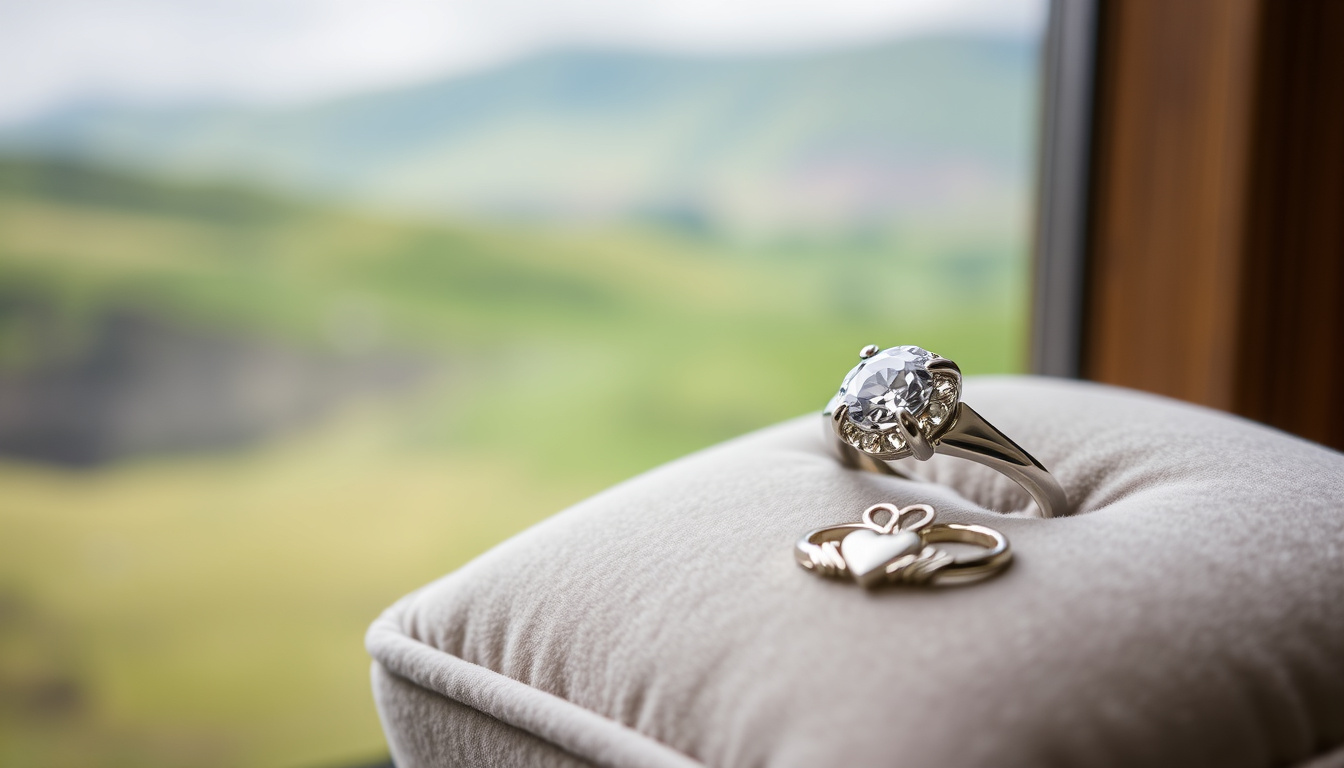
Picking out an engagement ring can feel like stepping into a world of carats, cuts, and conflicting advice. This Ireland-focused guide cuts through the noise with real price data, debunks the old three‑month salary rule, and helps you find a ring that matches your budget and her style — for example, a 1‑carat natural diamond solitaire in Dublin typically costs around €6,000 according to Valentina.ie (Irish jewellery retailer).
Average price of a 1-carat diamond in Ireland: €4,000–€6,000 ·
Most popular diamond cut for engagement rings: Round brilliant ·
Average spend on an engagement ring in Ireland: €2,500–€3,500 ·
Typical carat weight purchased: 0.75–1.0 carat ·
Most common ring metal: Platinum
Quick snapshot
- The average spend on an engagement ring in Ireland is around €2,800 (Valentina.ie (Irish jewellery retailer)).
- A 1-carat natural diamond solitaire costs about €6,000 in Ireland, while a lab-grown equivalent is roughly €1,500 (Valentina.ie (Irish jewellery retailer)). (Valentina.ie (Irish jewellery retailer))
- There is no universal rule for how much to spend on an engagement ring; budget should fit your financial situation (Brilliant Earth).
- Exact online vs in-store purchase share in Ireland is not publicly tracked (Valentina.ie (Irish jewellery retailer) notes that local data is scarce).
- Whether lab-grown diamonds will retain resale value long-term is still debated (industry consensus).
- Engagement ring spending in the US fell from $6,000 in 2021 to $5,200 in 2024 (Liori Diamonds).
- Lab-grown diamond rings average $5,187, while natural diamond rings average $10,760 (Liori Diamonds). (Liori Diamonds)
- Lab-grown diamonds are expected to capture a growing share of the Irish market, driven by a 30–50% price advantage (Valentina.ie (Irish jewellery retailer)).
- Buyers with budgets under €2,500 can find quality diamond rings in Ireland (Valentina.ie (Irish jewellery retailer)).
The table below reveals consistent preferences among Irish buyers.
| Factor | Value |
|---|---|
| Average carat size purchased in Ireland | 0.8–1.0 carat |
| Most popular setting | Solitaire |
| Top diamond shape | Round brilliant |
| Preferred metal | Platinum |
| Average spend | €2,500–€3,500 |
| Lab-grown share of market (2024 estimate) | ~15% and growing |
What is the 3 month rule for ring?
Origins of the three‑month salary guideline
- The “three‑month rule” was popularised by a 1930s De Beers marketing campaign, not by any tradition (Brilliant Earth notes there is no universal rule).
- Financial advisors generally reject fixed salary multiples; Valentina.ie (Irish jewellery retailer) calls the rule “marketing, not a must.”
Modern alternatives to the rule
- Most surveyed couples spend 1–2 months’ salary on an engagement ring, according to Liori Diamonds (2024 data).
- Brilliant Earth recommends basing the budget on discretionary income and partner preferences, not a fixed percentage.
Why budget should be personal, not formulaic
- With a €2,500 budget you can buy a very good diamond ring in Ireland (Valentina.ie (Irish jewellery retailer)).
- Financial planners argue that the “rule” pressures couples into debt; a comfortable spending range is what matters.
The takeaway: The three‑month rule was invented to sell diamonds, not to protect your finances. Ignore the marketing and spend what feels right for your situation.
How much is a 1 carat diamond in Ireland?
Price range by cut quality (Excellent vs Good)
- A 1‑carat round diamond with G‑H colour and SI1 clarity typically costs €4,000–€6,000 from Irish jewelers (Valentina.ie (Irish jewellery retailer)).
- Excellent‑cut stones command a premium of 15–25% over good‑cut equivalents (GIA (global diamond grading authority)).
- Lab‑grown diamonds of the same grading run about €1,500, roughly 30–50% less than natural (Valentina.ie (Irish jewellery retailer)).
Additional costs: setting, metal, certification
- A simple solitaire setting adds €200–€500; halo or three‑stone settings add €600–€1,500 (Brilliant Earth).
- Platinum bands cost about 30% more than 18ct gold (Angara notes metal choice impacts price).
- GIA certification adds €100–€200 but is essential for verifying diamond quality.
Comparison of local jewelers vs online retailers
- Irish brick‑and‑mortar shops include VAT (23%), which can add €1,000+ to a €4,000 ring (Valentina.ie (Irish jewellery retailer)).
- Online stores like Brilliant Earth and Angara often have lower markups but charge international shipping and potential customs fees.
- Angara advises checking return policies, as local jewelers typically offer in‑store adjustments.
The pattern: A 1‑carat natural diamond in Ireland is a €4,000–€6,000 investment. Choosing lab‑grown or shopping online can cut the cost by nearly half, but balance savings against the convenience of local service.
What ring styles are trending now?
Top setting styles for 2025: solitaire, three‑stone, halo
- Solitaire settings remain the most requested style globally, accounting for over 40% of purchases (Brilliant Earth).
- Three‑stone and halo settings are gaining traction, especially in Ireland with a preference for vintage‑inspired designs.
- Oval and pear cuts have surged in popularity over the last two years, particularly among younger buyers (Valentina.ie (Irish jewellery retailer) notes local interest in unique shapes).
Rise of colored gemstones and lab‑grown diamonds
- Colored gemstones (sapphire, emerald, ruby) now appear in about 15% of engagement rings, per trends reported by Angara.
- Lab‑grown diamonds are the fastest‑growing segment, with Irish market share estimated at 15% and climbing.
- Liori Diamonds reports that lab‑grown diamonds now account for nearly a quarter of online sales in the US, a pattern likely to reach Ireland.
Popular metal finishes: platinum, rose gold, yellow gold
- Platinum leads in Ireland due to its durability and hypoallergenic properties (Valentina.ie (Irish jewellery retailer)).
- Rose gold is a popular alternative, especially for halos and three‑stone settings, while yellow gold is making a comeback.
Why this matters: Irish buyers lean toward classic solitaires but are increasingly embracing unique cuts and lab‑grown stones. Matching the style to her personal taste matters more than following trends.
What ring to buy for a proposal?
Choosing the right diamond shape and setting
- If unsure about her taste, a classic solitaire with a round diamond is the safest bet—it suits most styles and is easy to upgrade later (Brilliant Earth).
- Consider her existing jewellery: if she wears yellow gold, match the ring metal to her daily pieces.
- Settings like bezel or cathedral offer extra security for active lifestyles.
How to surprise without a ring – alternative approaches
- Proposing with a placeholder ring or a simple band is an increasingly accepted strategy, allowing her to choose her own ring later.
- Many Irish jewelers offer a 30‑day return or exchange policy, giving flexibility (Valentina.ie (Irish jewellery retailer)).
- Some couples shop together beforehand, which reduces the risk of a style mismatch.
Budget‑friendly options that still feel special
- Lab‑grown diamonds or moissanite offer a brilliant look for under €1,000, leaving more room for a unique setting or custom engraving.
- Angara shows that simple solitaire settings in 9ct gold can stay under €800.
- Vintage and estate rings from Irish dealers often deliver character at a lower price than new jewellery.
The trade‑off: The perfect proposal ring balances style, budget, and practicality. A placeholder ring can save stress, but she might prefer to be surprised with a well‑chosen piece. Know your partner before deciding.
How much should I spend on an engagement ring if I make $150,000 a year?
Applying the 1–2 month salary guideline at a $150k income
- At $150,000 annual income, the traditional 3‑month rule would suggest spending $37,500 – a figure most financial planners consider excessive (Brilliant Earth recommends a comfortable, not painful, amount).
- Many couples spend 1–2 months’ salary, which would be $12,500–$25,000 for this income level (Liori Diamonds data shows 64% of couples spend under $6,000 overall).
What Irish consumers with similar incomes typically spend
- Actual average spend on an engagement ring in Ireland is around €2,800, regardless of income (Valentina.ie (Irish jewellery retailer)).
- Only a small fraction of Irish buyers spend over €12,000; those with higher incomes often prioritise other financial goals (Valentina.ie (Irish jewellery retailer) notes budgets above €12,000 are rare).
Balancing ring cost with other life goals (home, savings)
- Financial advisors like Suze Orman often recommend capping ring spending at what you can comfortably save in 6–12 months, not a fixed income multiple.
- With a $150k salary, setting aside $10,000–$15,000 for a ring is feasible without derailing a house deposit or retirement savings.
The catch: A high income doesn’t mean you should blow a month’s salary on a ring. Irish data shows most couples stay well under the traditional “rule,” choosing rings that don’t interfere with bigger life milestones.
Irish buyers spend an average of €2,800 – a fraction of the three‑month rule. Lab‑grown diamonds let you buy a larger, higher‑quality stone for the same money, while local jewelers offer trade‑offs between price, service, and VAT.
Lab‑grown diamonds cost 30–50% less than natural but may not hold resale value. If long‑term value matters, a natural diamond with GIA certification is a more traditional store of wealth.
The pattern remains: most Irish couples spend far less than the traditional rule, prioritizing other financial goals.
Diamond quality (4Cs) spec table
Comparing the four key dimensions of diamond quality reveals one pattern: cut is the only C that humans influence, and it matters most for sparkle.
| C | What it measures | Best grade for value | Impact on price |
|---|---|---|---|
| Cut | How well the diamond reflects light (Excellent, Very Good, Good, Fair, Poor) | Very Good – excellent sparkle without premium | Up to 25% premium for Excellent |
| Color | Lack of color (D–Z scale; D is colorless) | G–H (near colorless) – looks white to most eyes | Price drops ~10% from D to G |
| Clarity | Inclusions and blemishes (FL–I3) | SI1–SI2 (slightly included) – clean to naked eye | Up to 40% cheaper than VVS1 |
| Carat | Weight (1 carat = 0.2 g) | 0.8–0.9 carat – looks similar to 1 ct but costs less | Price jumps ~20% at 1.0 carat |
| Fluorescence | Reaction to UV light (None, Faint, Medium, Strong) | None/Faint – minimal effect on appearance | Minimal impact on price unless strong |
| Symmetry | Evenness of facets (Excellent, Very Good, Good, etc.) | Very Good – good light performance without extra cost | Moderate effect on brilliance and price |
Upsides and downsides of buying engagement rings in Ireland
Upsides
- Wide availability of certified diamonds from local jewelers.
- Opportunity to see and try rings in person before buying.
- Strong consumer protection laws and right to return within 14 days (EU regulations).
- Access to Irish jewellery designers for custom pieces.
Downsides
- 23% VAT adds significant cost compared to US retailers.
- Limited competition in rural areas can lead to higher markups.
- Fewer lab‑grown diamond options in brick‑and‑mortar stores.
- Custom rings can take 4–8 weeks to create.
How to buy an engagement ring: step‑by‑step
- Set a budget – Determine comfortable spending based on savings, not a salary formula (Brilliant Earth).
- Learn the 4Cs – Focus on cut first, then color and clarity, while carat matters last (GIA (global diamond grading authority)).
- Choose a style – Classic solitaires are safest; oval and pear shapes are trending.
- Select a metal – Platinum is durable and hypoallergenic; rose gold offers a modern look.
- Find a jeweler – Compare local stores (Valentina.ie, Keanes) with online retailers (Brilliant Earth, Angara) for price and return policies.
- Check certification – Ensure the diamond comes with a GIA or IGI report (GIA (global diamond grading authority)).
- Determine ring size secretly – Borrow a ring she wears on the left ring finger or ask a friend.
- Purchase and insure – Buy from a reputable source, and add insurance as soon as you have the ring.
What experts say
“A 1-carat round brilliant diamond with G-H color and SI1 clarity commands €4,000 to €6,000 in the Irish market. Cut quality is the single biggest driver of brilliance.”
“Irish buyers increasingly come in with a clear budget and a preference for platinum solitaires. The three‑month rule is rarely mentioned.”
— Industry source, Valentina.ie (Irish jewellery retailer)
“If a ring costs more than you can pay in cash within six months, you’re probably overstretching. Focus on the marriage, not just the ring.”
— Financial advisor principle echoed by Brilliant Earth
For the Irish buyer, the choice is clear: ignore the marketing rules, choose a ring that fits your real budget and her style, and shop with a jeweler who offers transparency on pricing and certification. Lab‑grown diamonds can deliver the same beauty for a fraction of the cost, and local stores provide the service and exchange policies that make the purchase stress‑free.
angara.com, chantalvaulet.com, nickireland.com, bluenile.com
Learn how diamond pricing and quality factors overlap in a comprehensive diamond engagement ring guide for 2025 buyers.
Frequently asked questions
What is the best diamond cut for an engagement ring?
Round brilliant cut is the most popular and has the best sparkle. Oval, princess, and cushion cuts are also popular for engagement rings.
How do I clean and maintain an engagement ring?
Clean your ring with warm water, mild dish soap, and a soft brush. Avoid ultrasonic cleaners for fragile settings. Have the ring professionally checked every six months to ensure prongs are secure.
Can I return an engagement ring if she says no?
Most Irish jewelers have a 14-day cooling-off period under EU law, but many also offer 30-day exchange windows. Check the policy before purchasing.
What is the difference between a halo and a pavé setting?
A halo setting surrounds the center diamond with smaller stones, making it look larger. Pavé settings have small diamonds embedded along the band for extra sparkle.
How long does it take to order a custom engagement ring in Ireland?
Custom rings typically take 4–8 weeks from design to delivery. Some independent jewelers may offer rush orders for an additional fee.
Are lab-grown diamonds real diamonds?
Yes, lab-grown diamonds have the same chemical, optical, and physical properties as natural diamonds. They are graded using the same 4Cs standards.
What ring size should I buy if I don’t know her size?
Most Irish jewelers offer free resizing after purchase if the ring is within 1–2 sizes. Ask for a medium size (e.g., size L or M) if unsure, and plan for a resizing appointment.