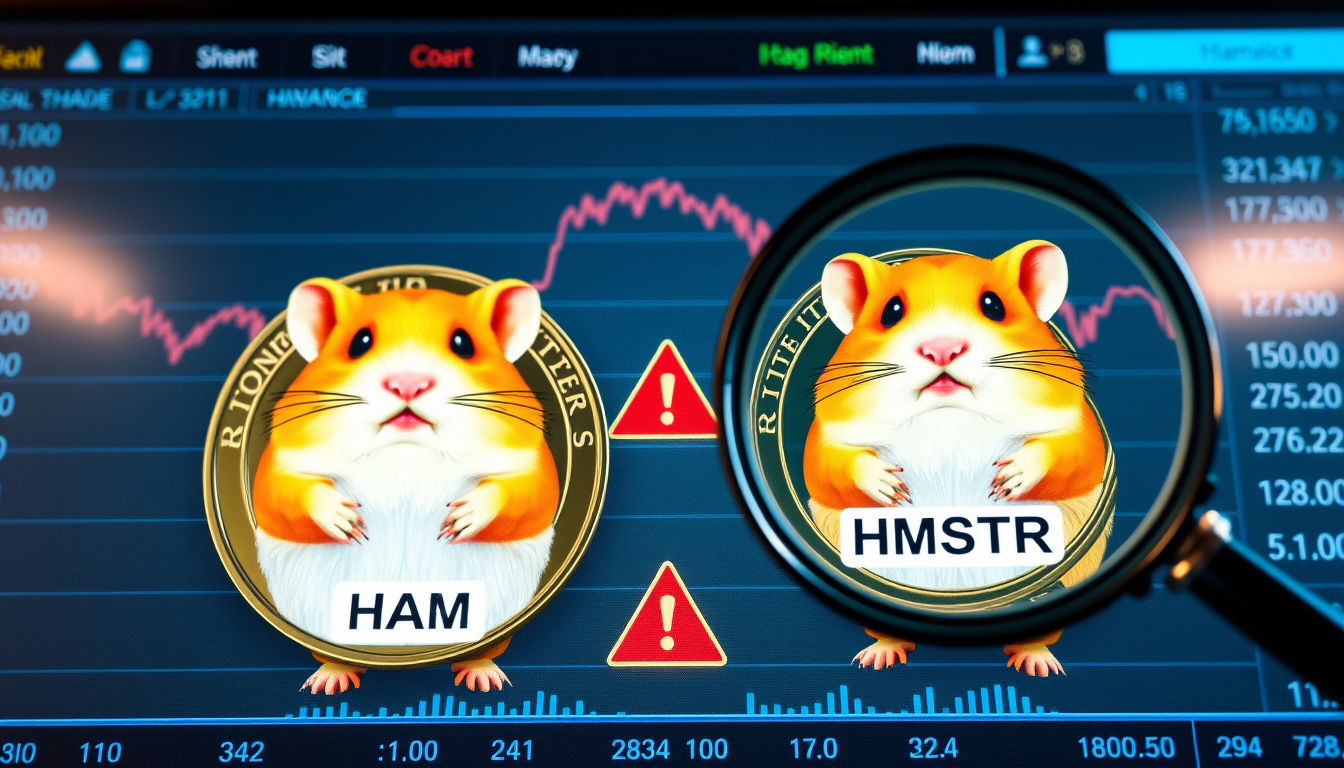
Searching for the price of a hamster coin today? You’re not alone — but the answer isn’t as straightforward as you might think. There are actually two distinct crypto assets both calling themselves hamster: the meme token Hamster (HAM) and the tap-to-earn game token Hamster Kombat (HMSTR). Their prices differ by orders of magnitude, so knowing which one you’re looking at is the first step.
HAM price (Kraken): $0.00000000033 ·
HMSTR price (Binance): $0.0001839 ·
24h volume HAM vs HMSTR: $58.6K vs $6.4M ·
HAM 24h change: -5.96% ·
HMSTR 24h change: +7.71%
Quick snapshot
- Two different hamster tokens exist: HAM and HMSTR (CoinMarketCap)
- HAM trades near $0.00000000033 on Kraken
- HMSTR trades near $0.0001839 on Binance
- HMSTR market cap is $11.8M (Binance)
- Which hamster coin the searcher actually intends
- Why HAM price varies so much across exchanges ($0.000000000115 on Coinbase vs $0.00000000033 on Kraken)
- Whether HMSTR’s recent volatility will continue
- HAM emerged as a meme token in May 2021 (CoinMarketCap)
- HMSTR hit an all-time high of $0.01154, then fell 92.99% in one year (Gate)
- Check the ticker symbol before any trade — buyers often confuse the two
- Monitor live prices across multiple exchanges for the most accurate snapshot
The price gap between the two tokens is staggering, not a rounding error.
| Metric | Hamster (HAM) | Hamster Kombat (HMSTR) |
|---|---|---|
| Launch | May 2021 (CoinMarketCap) | Unknown (ATH in 2024?) |
| Price range today | $0.000000000115 – $0.00000000033 | $0.0001572 – $0.0001842 |
| 24h change | -5.96% (Kraken) | +7.71% (CoinGecko) |
| 24h volume | $58,633 (CoinMarketCap) | $6.4M (Binance) |
| Market cap | N/A | $11.8M (Binance) |
| All-time high | N/A | $0.01154 (CoinCheckup) |
The pattern: HAM is a micro-cap meme token with negligible volume, while HMSTR has real market size and trading activity. Buyers must distinguish them before placing a trade.
A buyer who confuses these tokens risks a 1,000x error: HAM at mere fractions of a cent versus HMSTR with millions in liquidity.
Two Hamsters in the Crypto Jungle: HAM vs HMSTR
If you search “hamster coin price”, you’ll land on data for two completely different assets. Hamster (HAM) is a decentralized meme token that launched in May 2021, according to CoinMarketCap (leading crypto data aggregator). Hamster Kombat (HMSTR) is a token associated with a tap-to-earn game on The Open Network that quickly gained a large user base — CoinGecko (independent crypto analytics platform) lists it with a 64 billion circulating supply.
- HAM ticker on exchanges: HAM
- HMSTR ticker on exchanges: HMSTR
- They are not interchangeable — buying HAM when you mean HMSTR would be a 1,000x mistake.
The implication: the ticker symbol is the only reliable filter when searching for a hamster coin.
Live Price Snapshot: Where Do They Stand?
The cross-exchange price spread reveals who lists what.
| Exchange | HAM price (USD) | HMSTR price (USD) |
|---|---|---|
| Kraken (major US exchange) | $0.00000000033 | Not listed |
| Coinbase (regulated US exchange) | ~$0.000000000115 | Not listed |
| CoinMarketCap (market data aggregator) | $0.0000000001151 | N/A |
| Binance (global exchange leader) | Not listed | $0.0001839 |
| CoinGecko (independent analytics) | Not listed | $0.0001842 |
| Gate (popular altcoin exchange) | Not listed | $0.0001646 |
The gap: HAM’s price is roughly 1.8 million times smaller than HMSTR’s. Any trade involving “hamster coin” must first confirm which ticker is intended — the difference is not trivial.
Timeline: How Each Hamster Evolved
Tracking the history of each token helps explain their current values.
- May 2021: Hamster (HAM) launches as a decentralized meme token (CoinMarketCap).
- Late 2023 / early 2024: Hamster Kombat (HMSTR) emerges as a tap-to-earn game on TON, attracting millions of players.
- HMSTR all-time high: $0.01154 per token (CoinCheckup).
- HMSTR start price: $0.0002274 at first listing (CoinCheckup).
- 1-year change for HMSTR: -92.99% (Gate).
- Recent 24h change HMSTR: +7.71% (CoinGecko).
The two timelines run in parallel but never intersect. HAM has remained a low-volume meme token, while HMSTR experienced explosive growth and a subsequent sharp decline.
What’s Clear and What’s Not
Confirmed facts
- Both tokens exist and trade on separate exchanges.
- HAM price is approximately $0.000000000115–$0.00000000033 per coin.
- HMSTR price is approximately $0.00016–$0.000184 per coin.
- HMSTR has a market cap of $11.8 million (Binance).
- HMSTR’s 24-hour trading volume is over $4 million (CoinGecko).
What’s unclear
- Which token a user actually means when they search “hamster coin price”.
- Why HAM’s price differs so much between Kraken and Coinbase.
- Whether HMSTR’s volatility will stabilize or continue to fall.
The confusion is real: without a ticker symbol, a casual searcher may land on the wrong token’s data and make an expensive mistake.
A buyer who assumes any “hamster” listing is the same asset can lose thousands — always check the ticker.
Expert Perspectives on the Hamster Coin Confusion
Hamster is a decentralized meme token that emerged in May 2021.
— CoinMarketCap, description of Hamster (HAM)
Hamster Kombat’s all-time high was $0.01154.
— CoinCheckup, HMSTR historical data
The two quotes reflect the fundamental difference: one is a static meme token, the other is a utility token with a visible price range and trading history.
Frequently asked questions
What is the current price of Hamster (HAM)?
As of the latest data, Hamster (HAM) trades between $0.000000000115 on Coinbase and $0.00000000033 on Kraken. Prices vary by exchange and update in real time.
What is the current price of Hamster Kombat (HMSTR)?
Hamster Kombat (HMSTR) is trading around $0.0001839 on Binance and $0.0001842 on CoinGecko. The price has increased 7.71% in the last 24 hours.
Why are there two different hamster coins?
Hamster (HAM) is a meme token launched in May 2021, while Hamster Kombat (HMSTR) is a utility token from a tap-to-earn game on TON. They share a name but are entirely separate projects.
Which hamster coin is the real one?
Both are real — you need to identify the ticker symbol. If you see HAM, it’s the meme token. If you see HMSTR, it’s the game token. Check the exchange listing carefully.
Where can I buy Hamster (HAM)?
Hamster (HAM) is listed on Kraken and Coinbase (converter). You may also find it on smaller decentralized exchanges.
Where can I buy Hamster Kombat (HMSTR)?
Hamster Kombat (HMSTR) is available on Binance, Gate, and other major exchanges. Check each platform for the current pair.
What is the difference between HAM and HMSTR?
HAM has a price around $0.0000000001 and very low volume; HMSTR trades near $0.00018 with millions in daily volume. HMSTR also has a market cap of $11.8M and a known all-time high.
Is Hamster Kombat the same as Hamster?
No. They are different tokens with different tickers, prices, and ecosystems. Always verify the ticker before trading.
For any crypto investor searching for “hamster coin price,” the immediate action is to check the ticker symbol: HAM or HMSTR. Buying the wrong one could mean a factor of 1,000x difference. A buyer must verify the ticker before any trade.
Related reading: Geo Energy Share Price: Is RE4 a Buy? Analysts Say S$0.75 Target · CNMC Goldmine share price: forecast, fair value, dividends 2026